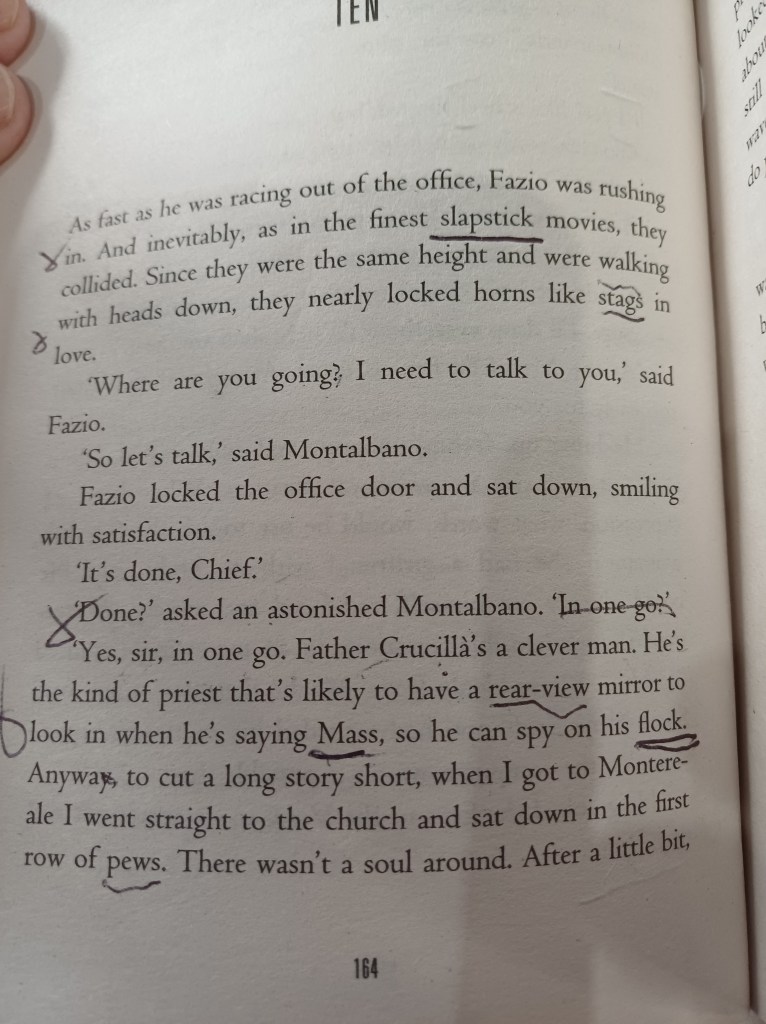
I have an Italian friend intent on learning new languages, in particular English. So, when we have a few minutes, we take out an English book and he reads a few pages aloud, marking words or phrases that are new to him, particularly those he feels he can use. There are some of course I warn him not to use in polite society and others I doubt he will have much use for, like for instance nappies, which is more British than my American. Then there are others which are specifically British, such as the boot of a car which in my American English I would call the trunk.
But there’s more than just enunciating words. I find that often as he reads I have to see as well as hear what he is saying. I have to tell him that attaching one word to another is not how it is done: “efficientreadymadeimages” read as if it were one word doesn’t really make sense. Until you break it up into “efficient, ready-made images”. A string of words, if not read intelligently, turns into nothing but a string of sounds.
Look, I tell him, there are those small black marks, which in themselves aren’t really words although we have given them names, that tell us how to read. A simple dot or period means stop a moment. A comma, a period with a tail, means pause. What we call a question mark tells you to raise your voice to let people know they can expect more information to follow. Then there are the pauses in themselves. If the “no” goes with the preceding word, it means one thing. If it goes with the following word that’s another. We have to know where to pause in the right place. I’ve discovered that poets often are terrible readers of their own poems.
Take the following paragraph. “If the goal is to get information about the world into your brain (comma – brief pause) a video should be much more efficient (colon: brief pause before continuing) for ready-made images (comma separating with pause from next piece of information) require no concentration (period – full stop. Catch your breath before continuing.) The skill of reading is unnatural like other skills learned, say macramé and chess. In fact, for most of history only a lucky few people could read and write.” Not only that but the symbols for sounds varied greatly depending on how they eventually evolved into languages, from cuneiform to Egyptian to any of the hundreds of languages we are barely aware of. There’s more to learning to read a new language, or any language, than the words.
Words in themselves, black marks on a white ground, are miraculous. As is the idea of a language that can transmit ideas or experiences. We still don’t really know how Language came to be.
Rudyard Kipling’s idea of how writing developed, transforming a sound into a symbol, is turned into a children’s tale. An open-mouthed carp with the sound you make pronouncing it soon comes to be identified with the sound, with that of an A.
Now how do I explain to my friend what the Italian equivalent would be of “I feel like a heel”? That it has nothing to do with Achilles. Then I discover the multiple meanings of heel. He looks at the word, mentally removes the H and asks me if it refers to the fish. True the Italians often aspirate an H where there is none. The fact that his mother tongue, until he was five or six, was French where the final S is not pronounced, doesn’t help. There’s an S there, I keep repeating, you have to say it. Back to heel. Can mean quite a few things. You have the heel of a loaf of bread. You have someone who is well-heeled. You can be head over heels in love. Telling the dog to heel makes sense since that is where you want your dog to come, to your heels. You can take to your heels. That also makes sense since when you are running away the last thing one sees of you are the heels of your feet. Down at the heels, I suppose that makes sense too, since when your shoes are really worn down that means you can’t afford to have them resoled and are therefore down at the heels.
I’m not a linguist and while I love words, I deeply admire linguists such as John McWhorter whose opinions I look forward to reading in the NY Times. One question though that doesn’t seem to have an answer is when and how we humans first discovered words and language as means of communication. Now what would we do without having invented a way of telling others what we feel or sense? What would I do if I couldn’t play around with words and write my blog every week?
I am ever grateful, fortunate, thankful that I have lived (and still live) in the hand-written letter era, before iPhones and emails. But more on that in a future post.
 Erika Bizzarri
I really enjoyed this one. I love words too especially learning their history and how differently many were used generations ago. I will look forward to your blog on hand-written letters… J3
PS. Diane and i return home to Bellocchio (and you) on Saturday, flying out Friday afternoon. It will take a few days to get oriented again and to be sure things are okay on the property (the boiler died while Noah and his family were visiting early May and we had to arrange for it to be replaced so we could have hot water when we get there. The work was just completed yesterday….) I hope we will see you next week.
Abbraccioni. (our friend Penny, chair of the Italian Dept at Yale signs off her letters to us with this. Is it her invention? Meaning “ Big Hugs”…). Mel Brooks famously says a version of this often: “Firm Embrace” as he gives you a big long hug. My friend Brad and I used to give each other what is sometimes also called a “bear hug”….same thing.
James
LikeLike
Dear Erika— a brilliant piece of work again!
ah-ha—- just out of curiosity I tasked ChatGPT with outling the derivation and all uses/meanings of the word “brilliant:”
The word “brilliant” comes from the Italian brillante (“sparkling”) and ultimately from the Latin beryllus, a gemstone name associated with shining or gleaming. Over time, it expanded far beyond literal light.
Here are the major meanings, shades, and derivatives:
⸻
Core Meanings of “Brilliant”
1. Extremely Bright or Shining
The original meaning.
Examples
● A brilliant diamond
● Brilliant sunlight
● A brilliant flash
Associated ideas
● Sparkling
● Radiant
● Dazzling
● Luminous
● Glittering
Literary use
Often used to describe:
● jewels
● stars
● snow
● eyes
● polished metal
● explosions
⸻
2. Exceptionally Intelligent
Probably the most common modern meaning.
Examples
● A brilliant scientist
● A brilliant child
● She’s brilliant at mathematics
Nuance
Not just “smart”:
● unusually insightful
● inventive
● mentally agile
● gifted
A “brilliant mind” suggests:
● creativity + intelligence
● rapid comprehension
● original thinking
⸻
3. Outstandingly Skillful or Excellent
Used for performance or execution.
Examples
● A brilliant performance
● A brilliant strategy
● A brilliant novel
Implies
● elegance
● effectiveness
● mastery
● near perfection
In British English especially, people casually say:
● “Brilliant!” meaning “Excellent!” or “Fantastic!”
⸻
4. Vivid or Intense in Color
Used in art, design, and nature.
Examples
● Brilliant red
● Brilliant blue sky
● Brilliant autumn leaves
Implies
● saturated
● vivid
● striking
● eye-catching
⸻
5. Magnificent or Splendid
An older, somewhat grand literary use.
Examples
● A brilliant court
● A brilliant society gathering
Associated with
● glamour
● prestige
● spectacle
● grandeur
⸻
6. Witty or Sparkling Conversation
Used metaphorically for social intelligence.
Examples
● A brilliant conversationalist
● Brilliant humor
Suggests
● quick wit
● charm
● verbal sparkle
⸻
Scientific / Technical Meanings
Optics & Physics
“Brilliance” can refer to:
● intensity of emitted light
● radiance
● luminosity
Example:
● brilliance of a laser beam
⸻
Gemology
A “brilliant cut” is a specific diamond-cutting style designed to maximize reflected light.
Example
● Round brilliant cut diamond
The term directly connects to:
● sparkle
● fire
● scintillation
⸻
Emotional / Psychological Connotations
“Brilliant” often carries emotional warmth unlike merely “intelligent.”
Compare:
● intelligent = capable
● genius = rare intellect
● brilliant = intellectually dazzling
It implies:
● energy
● brightness
● vitality
● inspiration
A brilliant person often feels “alive” mentally.
⸻
Common Derivatives & Related Forms
Noun: Brilliance
● brilliance of the stars
● intellectual brilliance
Can refer to:
● light
● genius
● excellence
⸻
Adverb: Brilliantly
● brilliantly written
● brilliantly lit
● brilliantly conceived
⸻
Noun: Brilliancy
Older or more formal version of “brilliance.”
⸻
Verb Roots & Relatives
Brilliante (music)
In music:
● lively
● sparkling
● showy
Example:
● Allegro brillante
⸻
Synonyms by Context
Light
● radiant
● luminous
● dazzling
● gleaming
Intelligence
● gifted
● ingenious
● exceptional
● visionary
Performance
● masterful
● superb
● outstanding
Color
● vivid
● vibrant
● intense
⸻
Opposites / Antonyms
Depending on context:
For intelligence
● dull
● mediocre
● obtuse
For light
● dim
● murky
● shadowed
For color
● faded
● muted
● drab
⸻
Cultural Usage Differences
British English
“Brilliant!” is extremely common as casual praise.
Equivalent to:
● awesome
● great
● perfect
Example:
“Tea’s ready.” “Brilliant.”
⸻
American English
More often reserved for:
● intelligence
● exceptional achievement
Calling someone “brilliant” in the U.S. sounds stronger and more formal.
⸻
Philosophical / Symbolic Associations
Because it combines:
● light
● intelligence
● beauty
● vitality
…the word often symbolizes enlightenment itself.
In literature, a “brilliant” figure may suggest:
● dangerous genius
● charisma
● divine radiance
● tragic intensity
A brilliant object attracts attention. A brilliant mind illuminates understanding.
That metaphor of light becoming intellect is ancient and deeply rooted in Indo-European language traditions.
🙏
James back in Seattle
LikeLike
Oh boy!Your comment is longer than my post- Fascinaitng. brilliant things do turn up occasionally.
LikeLike
Ausgezeichnet/Eccellente, danke schön/mille grazie. Just think if your friend, or anyone visiting the USA who is first learning English, would ever listen to an American basketball or baseball game, he/she would hear at least:
Basketball:
A hook shot
A sky hook
A high arch
An alley-oop
A runner
A floater
From downtown
Nothing but net
In and out
Rattled around
A fast break
A slam dunk
In the paint
A tre
A double double
A triple double
A turn over
Stepped on, or over the line
An assist
Fed him under the basket
In the bucket
Drove the lane
An offensive foul
A foul shot
Fouled out
A moving screen
A brick
A lane violation
Double team
A zone defense
Goal tending
Off the glass
Shot Clock
A shot clock violation
A jump Ball
A tie-up
A rebound
A time-out
A possession arrow
Collapse on the ball
Kick-out
His night comes to a close
A ton of success
A put down
A 20 point swing
Avoid getting swept
An airball
Throw it down
Over the top
He buries it
Gets the bounce
A beautiful pass or drive
A clean block
A fade away
A prayer
An answer
A match-up
A buzzer-beater
3 ball
Misses a 3
Scoop shot
Finger roll
A tip-in
March Madness
Bracketology
Baseball:
A ground ball
A pop fly
A routine out
A line drive
A blooper
A line drive
A home run
A triple
A double
A single
A broken bat
A base
Left on base
A stolen base
Caught stealing
Home plate
A steal of home
A rundown
Safe, or out at the plate.
Rounding the bases
A grand slam
A foul ball
A bunt
A ball
A strike
A walk
A passed ball
A wild pitch
A shortstop
A Dugout
On deck
A warning track
A foul line
A foul pole
An infield
Infield fly rule
An outfield
Over his head
Misplayed the ball
Stepped off, was pulled off the bag
A closer
A pinch hitter
A double switch
Runs, Hits, Errors
…then here is hockey, football, soccer, boxing, etc.
O mio Dio!
LikeLike