8:30 a.m. My son has just finished giving his 17-year old cat her breakfast. Now he turns to his 96-year old mom before making his way upstairs to his computer studio via the spiral staircase that brings to mind an Austrian chalet and not an Italian farm house. The stairs reflect my father’s Germanic origins and turned out to be a problem when he had a stroke (the bedroom was upstairs) and the nurses had to figure out a way to carry him down to the ambulance, solved by improvising a sling from a blanket.

I have asked my computer genius son once again how to change the name of a file, or folder, after discovering that I had over a hundred photographs identified only by number stored in my computer. He is immured to having a technologically impaired mother and gives me a despairing look as he puts another capsule in the espresso machine. But’ I’ve already told you! he says impatiently. Select. Space bar. Space bar. Enter. Write. Enter.
Yes, I know you’ve told me, but I don’t know what to do when you say Enter. Oh. OK. it’s that tab over on the right that moves the text down to the line below. So, I enter, then write in the new name, over the old. Then enter again and that’s it.
But it’s also the sequence that eludes me. I insist. Guess you had better write it down. He grabs the pen and a discarded Postel envelope, then writes down the instructions, in capital letters, with arrows indicating the sequence. Before some kind of updating, my file and edit icon used to be up in the left corner. Then it somehow disappeared and I had to learn all over again how to put a word in italics or bold face using a combination of keys. Yes, your mother is hopeless.
The fault, if we can call it that, goes back to when I was in high school, in an imposing building in a town that flanked the Merrimack River in Massachusetts. At the time, my father was teaching biology in Bradford Junior College, for elite girls only, located on one side of the river. When school was over I would wander over to the A&P near my high school. My father had befriended the owner of the supermarket and would snap up cans that had lost their labels and yesterday’s pound cakes at half price. While he was teaching, my sister and I would sneak down to the freezer locker in the college basement to snitch some of the pecans off the icing. The coffee cakes, with only half their pecans still in place, eventually made their way to our customary German afternoon coffee break.

The route to the junior college, where I might get a ride home when my father had finished his classes, led downhill from my high school to a four-light crossing where I was often tempted to jay walk instead of waiting for those interminable traffic lights to change, first on the right, then on the left. From the bridge, I looked down on the river that runs through Haverhill, a textile and shoe manufacturing town, before I ambled on into the suburbs with its tree-lined streets and neat clapboard houses, to the college on its own park-like grounds.
That was years ago, around 1940, and it is now 2025. The former high school currently houses the municipal offices. When it was still a high school, it had also offered optional courses including Latin with Caesar’s de Bello Gallico, home nursing, typing and shorthand. Latin was probably something chosen by those who envisioned continuing a higher education. Because both my parents had their PHDs, Latin seemed an obvious choice for me. Problems arose when my mother offered to help me, for her Latin had been learned in a lyceum in Germany and her pronunciation certainly differed from that of my New England teacher’s. Homework once included an excerpt from Caesar’s chronicles, and while my translation made perfect sense to me, it turned out to be all wrong. Home nursing seemed sort of stupid, showing you how to fold the sheets into perfect corners when you make a bed and how to take a temperature. Touch typing though, well that was something that might come in handy, and I turned out to be pretty good at it and soon was typing the pangram “The quick brown fox jumps over the lazy dog”, using all the letters of the alphabet.
In 1956 I had a notebook where I would jot down my adventures as I traveled through Europe. A typewriter would certainly have made things easier when writing my daily reports home. When I got to Florence, in Italy, a better way of recording my impressions topped my list of future acquisitions. I can see myself now, tall and looking anything but Italian as I wandered along the Arno looking in shop windows. I was wearing a skirt (trousers or jeans weren’t acceptable for women till around 1970) and Roman type sandals with thongs that laced up around my legs. A shop with typewriters in the window caught my eye and I thought I might as well ask. Yes, they said, we have one in stock, a portable Olivetti 22, top notch for the times, but it has an American keyboard, they added. Lucky me, I thought, and snapped it up. I later found out that in the Italian keyboard a few of the letters were switched, I think it was the w and the z, but I eventually learned to compensate when I had to use other typewriters. Thereafter when people asked what the American did, they simply answered, oh, she writes, for they could hear the tick-tick of the typewriter pretty much day and night.
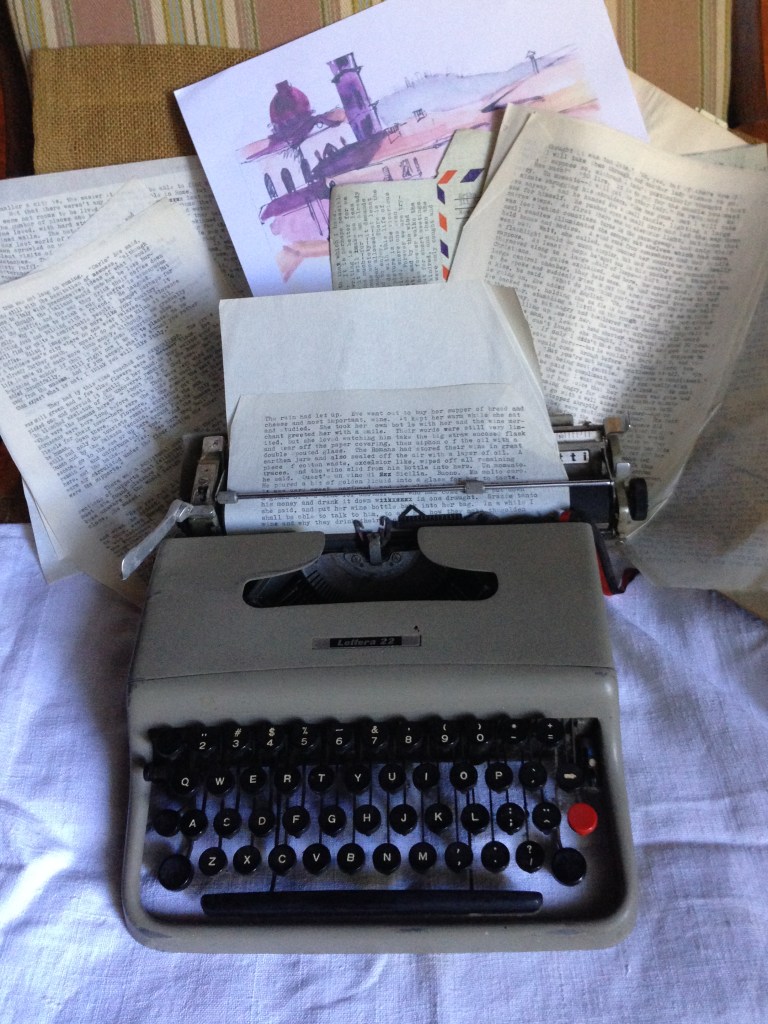
Much later, after marrying my archaeology husband, Mario, I also became his typist for a book he was translating on the archaeology of Palestine. Mario was nonplussed when the author, after injuring an eye during a dig, said he resembled the man in the Hathaway shirt. Luckily, I knew that it was a reference to the patch that the Hathaway man had over one eye in ads for that famous brand of shirts. Later, as I got further into the world of translation, a copy was also required, and while one could white-out a mistake in a typed word, the carbon copy was more of a problem. Sometimes I might have to retype the whole page before sending the translation to Florence with Giannino, the courier. He took the trip to Florence every day, not just for me but also for others who might need something not available in small-town Orvieto. I suppose Amazon hadn’t started its services yet. Once, when the editor who handled my translations was on the Rome-Florence train, we coordinated his arrival in Orvieto, where I waited for him at the station. When the train pulled in, he leaned out the window, didn’t even have to get off, and I handed him my translation to be delivered to Alinari in Florence.
Eventually, my boys insisted that I leave the Stone Age and learn to use floppy disks instead of a typewriter and carbon copies. I also had an electric typewriter, quite a monster, particularly useful in helping a friend with her thesis on the Grand Tour in Umbria. Before long an Apple computer came along and I learned to send my files by email, after running them through spell-check, a sort of antediluvian ancestor of A 1. Spell-check was useful but, like A 1, also needed the human touch. As the array of dictionaries, mostly Italian-English but also some from German, gave way to spell-check and computer definitions, they were relegated to the shelves above the desk. When I wrote “the Madonna” referring to the Virgin Mary in a Sienese or Florentine Renaissance painting, spell-check insisted it was a mistake and that the article “the” was unwanted here. I figured out that for the computer Madonna was only the American pop star.
Somehow over the years, alone in my study in the villa, I learned to do a lot of things on my computer. Trial and error. Self-taught. Now with nothing particular to do, I decide to go over the scores of files, in particular photographs, identified only by number. Since I had never given them names I was unable to call them up when needed. Just change the name, my computer savvy son said. This is how. And he gives me a technical explanation. It works, but alas, my mind refuses to be updated. OK. I’m 96 so perhaps it’s not surprising, but even ten years ago I had the same problem. All because I write automatically, have always done it that way, and never really knew what the keys were called. The same holds true for messages on my phone. The keys are the same, but I have to hunt to find this letter or that. In touch typing the words simply seem to flow from my brain to my fingers to my computer. It fascinates me to watch my granddaughter fly over the keys on her phone, knowing just where each letter is as she digits her messages. It is another generation and even secretaries or bank clerks use the hunt and peck technique that I will never master.
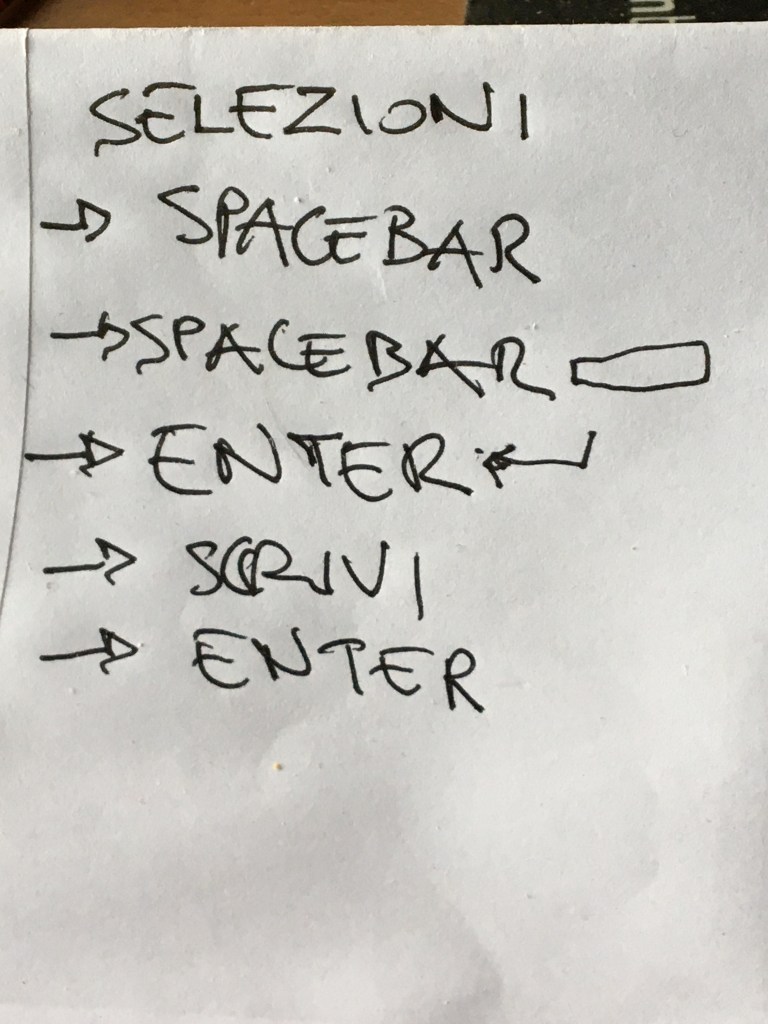
Select, spacebar, spacebar, enter, write, enter.
 Erika Bizzarri
Yes, yes! But what about the passwords?😳❤️
LikeLike
I like the thought that your boys urged you to leave the Stone Age and learn to use floppy disks! Now even floppy disks seem prehistoric. Frankly you do amazingly well, but where’s the surprise in that?!
LikeLike
Ahh what would you do without Lamberto and his wonderful patience. Mike
LikeLike
Evolution! In my early forays into translation I used Carolyn’s manual typewriter (perhaps passed on from you?). At first I typed carefully and managed to avoid much re-typing. Grant taught me to use an Apple computer in about 1989. My first experience with online translation was rewriting what the early version of the software produced. Fra il 1816 e il 1820 became Among the 1816 and the 1820. Much has improved!
LikeLike
Above from James (the Second) Varah
LikeLike
Cara,muchley enjoyed reading your latest BLOG.Typed a reply of some length but alas was unab
LikeLike