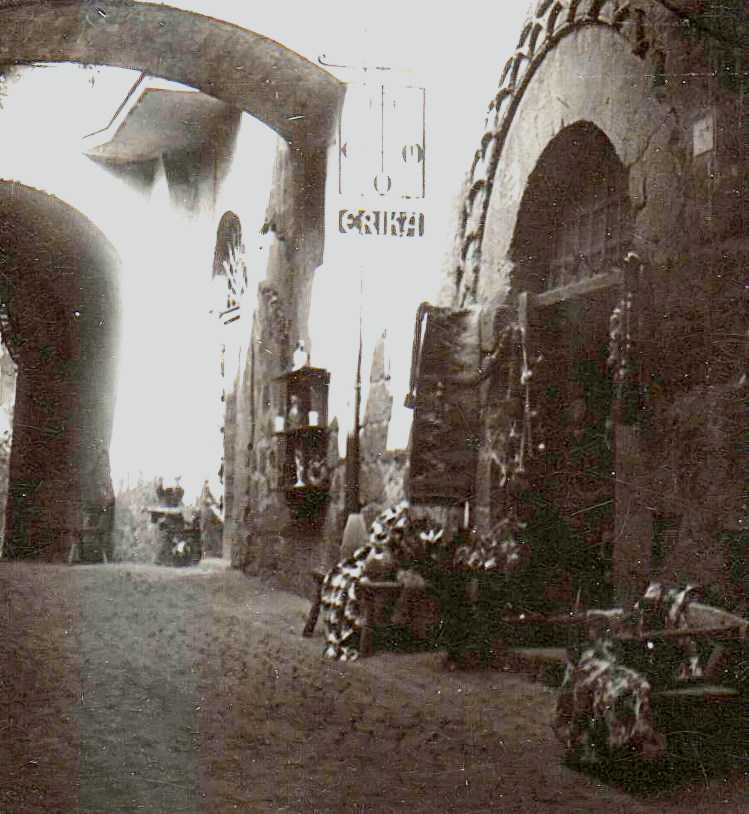
I am in my shop just off Piazza Duomo when Carlo stops by. If you don’t have anything better to do, I’m going to see a friend in a small town in the hills. Want to come? Well, yes. I don’t have anything better to do and my sales assistant will see to the shop, so I accept the invitation. Carlo is the brother of a friend of mine who is married to the head doctor of the local hospital. The family comes from Parma and when he comes for a visit, since he has nothing better to do, he walks a lot, often to the surrounding villages. Sometimes on his return he’ll bring me a rose he has purloined from someone’s garden.
This time he has a car and the town he has in mind isn’t more than 15 minutes away. He drops me off at his friend’s, saying he has other things to do, never did learn what, and will pick me up later. This friend turns out to be a retired school teacher, a handsome middle-aged man with a shock of silver hair, a widower with a teen-age son and a daughter studying at the university in Florence.
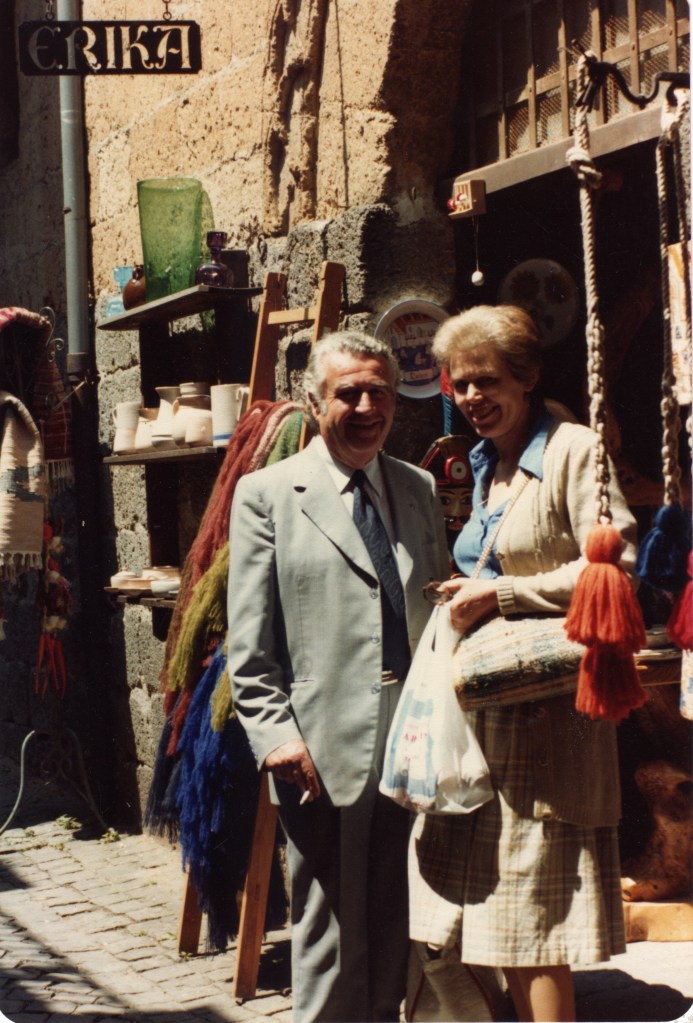
No sooner have I arrived and climbed the stone steps leading from the street to the apartment, than he receives me into the kitchen, first room on the left. The large table with a dusting of flour still visible is where his sister makes incredible tagliatelle, rolling out the sheet of pasta so thin you can almost see through it. After pulling up a chair, he goes back into the pantry and brings out a whole ham, a prosciutto, impaled on three iron prongs, and half a loaf of dense home-made bread. I watch him as he cuts thin slices of deep red prosciutto marbled with pink fat with a long thin knife that years of use have reduced to half of what it originally was, before turning his attention to the bread, cutting slices with a serrated knife.
He pours me a glass of white Orvieto wine from a flask that reminds me of when I was in Florence shortly after coming to Italy and used to buy the local wine sold by the measure for my evening meal. The rather portly shop keeper, after feigning an interest in the buttons on my sweater, more perhaps in what was underneath them, before pouring out my half liter, eliminates a layer of oil floating on the surface of the large flask behind the counter. I am curious and he explains that it keeps the wine from oxidizing – the way the Romans used to do. Come to think of it, he himself could have been an ancient Roman.
I can still call up the flavor of that bread, which I’ll choose any time over cake, and of the home-cured prosciutto. Time passes as this newfound friend regales me with stories of his life as he cuts still another slice of prosciutto. I think he was a bit nonplussed by having Carlo drop this Americana off at his door, a wayfarer suddenly turning up, Odysseus washed up on the Phaeacian shores, and didn’t know quite what to do with her. Homer teaches us that the first sign of hospitality is offering food, breaking bread. Wherever Odysseus stopped in his wanderings, he was a guest and as such was feasted before telling his hosts where he had come from and what his adventures had been. It was the ancient Greek custom of xenia, or hospitality, a social bonding.
So, after the prosciutto has been returned to the pantry, and our glasses refilled, quite permissible since it would after all soon be getting close to supper time, we begin sharing our adventures. I don’t remember now what I told him of my life, but I remember what he told me of his.
Sipping his wine, made from their grapes grown down in the valley, he tells me how during the war they hid the prosciutto in an olive tree to keep it out of the hands of the German soldiers passing through. (In the following months, I was to hear many other stories in the life of this retired schoolteacher, known locally as Maestro or Teacher, who over the years had taught all the children in the village. The school was a one-room affair and his pupils might range from 6 to 12 years in age.) It wasn’t easy, you know, he tells me, to give the pupils assignments in keeping with their year of studies, no two alike : arithmetic, literature, history, writing. They all learned to read and write and some went on to the lyceum and even the university.
It’s not unusual for us to have earthquakes although there haven’t been any recently. I guess you haven’t been here long enough to experience any. Generally, there are only mild shocks but when they are stronger, pots and pans will start rattling and the floor seems to dance under your feet. Everyone goes out and sleeps in the street. There was one earthquake, felt in Orvieto and throughout the region, where the olive tree under which I was sitting suddenly whiplashed, and I found myself flat on my back.
We often didn’t have enough to eat and a sausage was a real treat to be eaten with polenta. I would get a whole sausage only if I was sick and my mother thought I needed extra nutrition. We ate a lot of polenta, for breakfast too, maybe with a bit of fat to give it more flavor. The kids my age and I were always on the lookout for something to eat, sometimes robbing the eggs from a bird’s nest. When the roosters were castrated, we would fight to get hold of the testicles to be roasted and eaten as a snack.
My father was a peasant, a tenant farmer, which was how things were at the time. He could keep part of the wheat he grew but the larger part went to the owner of the land. Sharecropping has been outlawed since then. My father wanted me to get an education and in order to become a teacher, he explains, I had to finish pre- university studies in Rome. I would take a cardboard suitcase, tied with a rope, full of dried beans to pay for my upkeep when I went to the big city. I had found lodging in a tiny room under some stairs.
After that, I had been aiming to go to university in Naples, but then there was the war and my parents thought it best I stay close to home. Now, when you read of the bombings by the Nazis and the Allies, it was a good thing I didn’t go, for when peace was finally declared Naples was a shambles, and over 60% of the buildings no longer existed. Like all young Italians I was eventually drafted and sent to Greece. I was supposed to shoot at the enemy the other side of a hill and suddenly realized he was just a kid like me. My older brother ended up in the north near Trieste.
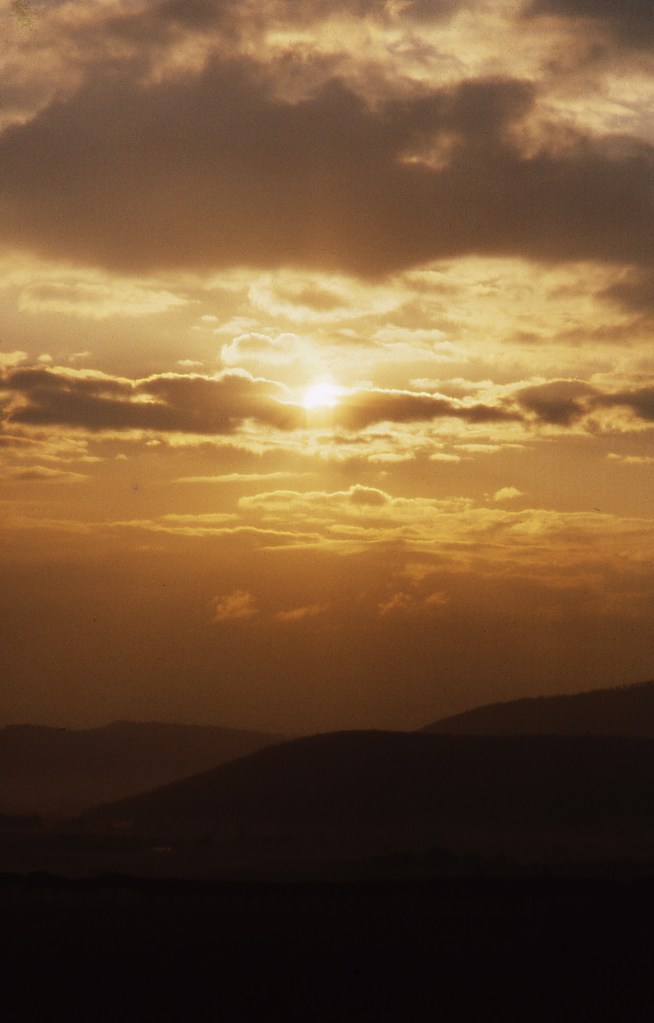
Some things one never forgets. Have you ever seen the sun come up over the ocean? he asks. Once when I was in a seaside town I got up early and made my way to the top of a hill overlooking the sea. The sky slowly got lighter as I looked down from my perch and then, suddenly, there was the sun, in all its glory. It was so breathtaking, I fell to my knees in awe.
Time passed as we talked, although I think he did most of the talking. Stories of ghosts and what it was like to grow up in a village that had few resources of its own, where you might barter an egg for that extra sausage. Before long we heard Carlo coming up the stairs and it was time to go back to Orvieto. We had made new friends, each of us. We had broken bread together and shared experiences. That’s what breaking bread, communion, means. It is xenia.


❤️❤️❤️
LikeLike
Life’s education
LikeLike
Such a fascinating recollection. The time and place seem so far away from my here and now, but drawn closer through your retelling! I enjoyed the parallels with Homer too.
LikeLike
Erika, I am currently visiting the Greek islands and I got to experience xenia first hand. Thank you for educating me on the meaning of that word. As always, Mike Shaughnessy.
PS: I am currently visiting the Amalfi coast and from here I will be going to stay in Orvieto before returning home on October 8.
LikeLike
I really enjoyed this post which filled in some gaps for me in a way that only you could have done. As always, so many wonderful details!
Do you think your friend had an ulterior motive for introducing you to this gentleman and then slipping away?
In any case, the rest is history that I was glad to learn.
LikeLike