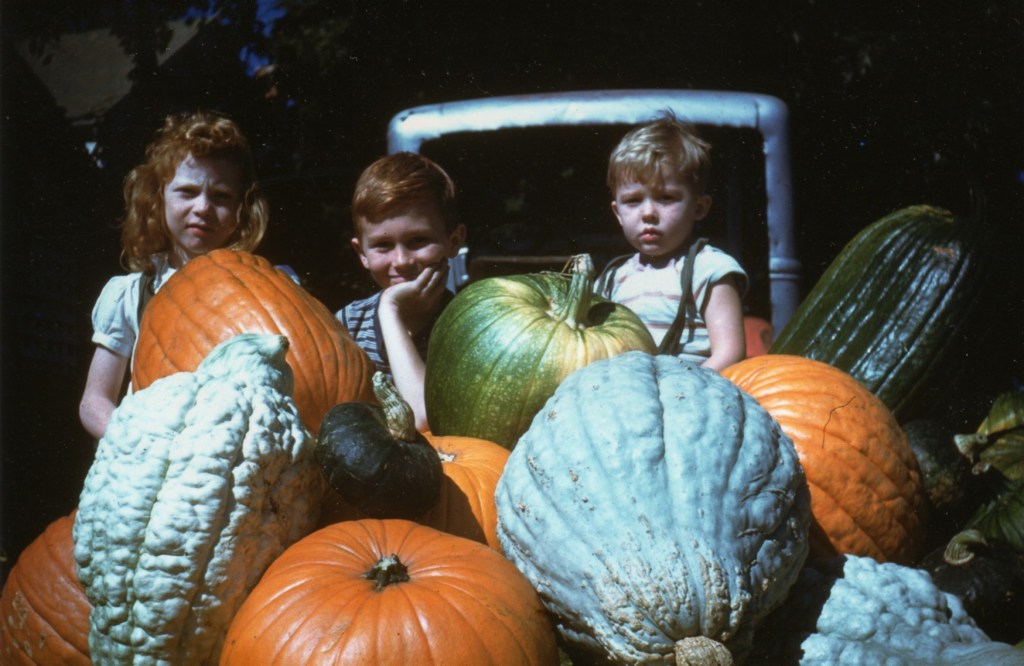
THANKSGIVING. TO WHOM SHOULD WE GIVE THANKS?
Really don’t know why, as a family, we celebrated Thanksgiving. Or even Christmas or Easter in a household that is eminently non-religious. Although Thanksgiving is not a religious occasion. I suppose Columbus called what we call turkey, pavo, in Portuguese or Spanish. The Puritan invader who arrived on the Mayflower must have been delighted with this large bird they called turkey, for Columbus thought he had reached the country known as Turkey. American children grew up with the myth that their Puritan ancestors had learned from the native Americans, the Iroquois, what foods to grow and how to take care of the land. They revered nature and taught the newcomers the three sisters concept, with maize, beans and squash supporting each other. Unfortunately, the descendants of the newcomers evolved into the farmers of today, most of whom were interested in turning crops into profit. Many of the teachings of these original dwellers were later ignored and it probably would have been better if the native settlers had succeeded in sending the Puritans back to where they had come from. However, as the story goes, after a long and difficult winter the original inhabitants and the invaders sat down together to share a banquet and this was the beginning of what we now call Thanksgiving.
Thanksgiving continues to be a celebration of an abundant harvest, a family event. A friend of mine whose family had emigrated from Canada, and Sicily, got together each November on a farm in northern New York for a meal participated in by over 80 family members of various ages, coming from various parts of the country. When I was a child, we too celebrated by trying to make sure that everything on the table had been produced on our farm, from the turkey which was generally replaced by a goose, to pumpkin pie as we thanked the native Americans, the Iroquois, who originally lived here, for having taught us what it meant to take care of the land to which we really had no right.
Back in the 1970s when I lived in Italy, I discovered that no one had any idea of our American thanksgiving and roasting a whole turkey was quite a novelty. You could roast a whole pig, but a turkey? I can still see myself looking up at the butcher as he stood behind the counter and proudly brought out the bird I had ordered, and then shrinking back in horror as he started to “dismember” It. “Stop!” I cried as he cut away the skin over the breast bone. Since I was preparing the stuffing, I had to find a solution to keep the bread and sage and apple and onion mixture inside the bird to soak up the flavorful juices. Suddenly I had a bright idea and bought a chicken, with the skin serving for a plastic surgery job to keep the stuffing in as the bird was being roasted.
While Thanksgiving is synonymous with family, traditionally it is the last Thursday in November. One year our sister city, Aiken, in South Carolina, came to Orvieto to offer the city a thanksgiving dinner even if it was October. There must have been over one hundred guests and we had six turkeys. The Orvietani had let us know ahead of time what supplies were needed. No problem with six turkeys, although they were taken aback when they were told that they had been delivered, “without legs”. Oh dear, no drumsticks? Of course, they did have their legs and the Italian intermediary had translated the term zampe or feet as legs. The corn they had ordered arrived in the form of ten bags of popcorn, not exactly what the Aiken cooks, including Liz Benton, renowned for her Angel biscuits, had expected. Her biscuits were gobbled up even before the rest of the meal appeared, while the Orvietani, somewhat perplexed, politely waited for Grace to be said.
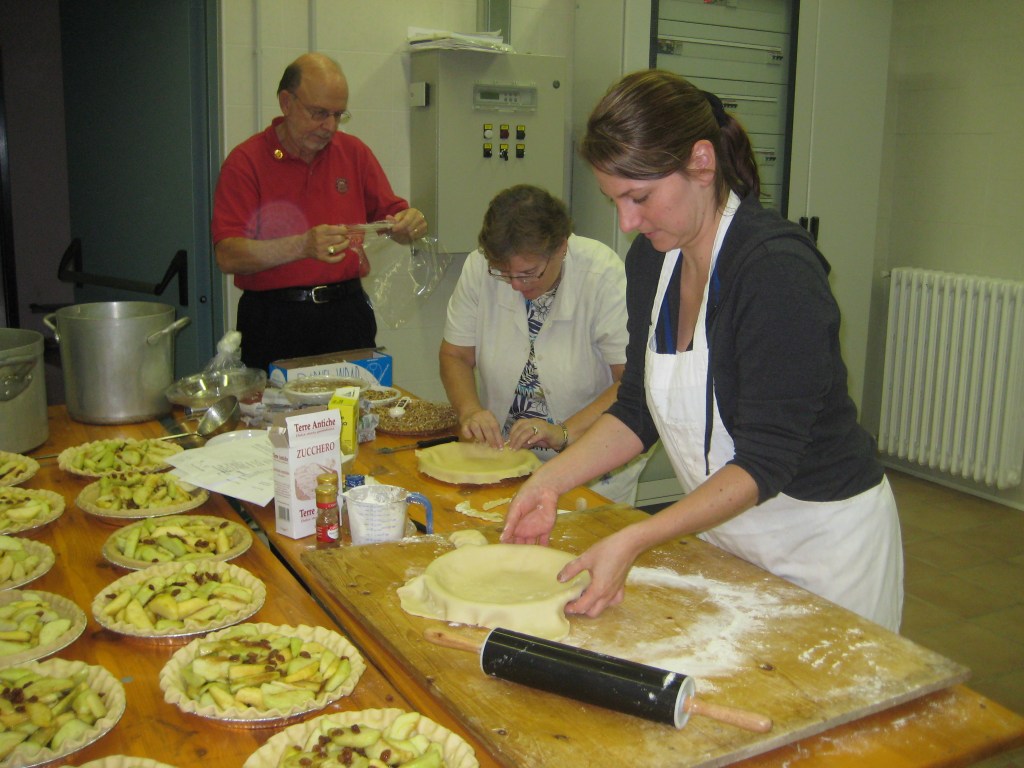
As the American mother of the Italian coordinator of the Arizona University group, preparing the turkeys for the final Thanksgiving dinner was up to me. One year there were so many students we had to order four big birds. They were all roasted in various ovens, including that of San Lodovico, a religious bed and breakfast whose mother superior offered to help out when we found we were short of one large oven.

My favorite turkey story though is what might possibly be called an Etruscan banquet. After all, the Etruscans were known for the banqueting scenes in their tombs. It was October and my son came through the door of my house in the country and asked if I could prepare a turkey a friend had raised. Sure, I told him. How much does it weigh? Oh, around 50 pounds! I did a double take. My God, that’s not a turkey, that’s a dinosaur! It took some doing but once the bird was ready there was a problem we hadn’t thought of. It was way too large to fit into any of our normal ovens. A friend who often roasted a whole pig in his pizza oven, stepped in. I forget now how many hours were required. The banquet was in a shed in the country and after the Italian guests had surprisingly accepted my first course of corn chowder (made with milk!), and even asked for seconds, trumpets sounded and four young men appeared carrying the turkey in on a litter. Of course, the Etruscans wouldn’t have had squash or corn or potatoes. Or even a turkey. The banquet however was a success.
 Erika Bizzarri
Happy Thanksgiving Erika!!! We are thankful for YOU and that wonderful holiday memory.
LikeLike
Beautiful memories!! Mike
LikeLike
I’m going to read this to my litt
LikeLike
Great stories, Erika! Happy Thanksgiving!
LikeLike
Happy Thanksgiving! I am thankful for having had you as a teacher (my favorite) early in my development, on the road to being a lifelong lover of Art and the Arts. I always think fondly of the time I spent in Orvieto. Thank you from the bottom of my heart.
Love always.
Tom Tiberio
LikeLike
Wonderful story. And as today is Thanksgiving over in the USA, may I wish you a Happy Italian Thanksgiving!
LikeLike
Happy Thanksgiving to you Liebe Cousine Erika. I wish that I had known about you during the eight (8) years I served with the US Army in Pisa/Livorno. My family and I would have made a special trip to Orvieto. Nevertheless, for Thanksgiving and Christmas we would buy two (2) turkeys from the US Army commissary and roast/prepare them for members of my Army engineer organization. My host nation employees were a bit skeptical at first, but on the 2nd year and thereafter they were always in great anticipation of “Gina” bringing two roasted turkeys. A few even asked if they could have the legs or wings — I told them to visit the “chef” and ask her. Of course she knew all my employees. As they approached to ask her, I gave Jean the “head nod” to accommodate them. These special events with my host nation employees were the best times that we shared together. Especially, while in Germany, a plethora of people from different nationalities worked for the US Army. For Christmas, each of the people brought in a special dish that was popular and revered in the country of their birth. What a great celebration to share each other’s friendship and food during this special time. Il Tacchino Arrosto oder Truthahn Geröstet were the highlights of our get-togethers. Unfortunately after Jean and I returned to the USA in 2007 after 27 years in Europe, I was informed that there were no more team-building sessions where people gathered together and enjoyed each other’s company and the special food dishes. Schade, peccato, too damn bad. I am still in contact with many of my devoted host nation employees in Italia and Deutschland. Until this day, 18 up to 45 years later, we still memories of the good old days together. Many have told me that they can hardly wait for Jean and me to return for visit, and that the welcome will be magnanimous. That makes us feel very special and loved.
LikeLike