It must have been in the seventies. A friend of ours, one of several Marios around, was teaching a course on Romanesque art in Florence, for which a tour of France, Sardinia and Tuscany had been organized. First a word about Mario Bucci, a professor we all loved, perhaps because of, or in spite of, his unpredictable enthusiasm. His eyesight left much to be desired, but his enthusiasm was contagious. He was teaching art history at the time in Florence and I got the chance to join the group as a sort of assistant, helping to assign rooms and explaining things his imperfect English made hard to understand.
Romanesque art had always been one of my favorites, in particular the stone lions guarding the entrances to a church and the fantastic animals twined around the columns. Mario had pointed out that the lion, like the other scenes, were symbolic for it was believed that when the cubs were born they had to wait until their father breathed life into them after three days. Unfortunately, at the moment my books on Romanesque sculpture and my sketchbooks from the trip are. as they say insabbiati, or buried, at the villa, moved from where they had been sitting for years to the basement when my son needed the space for his computer equipment.
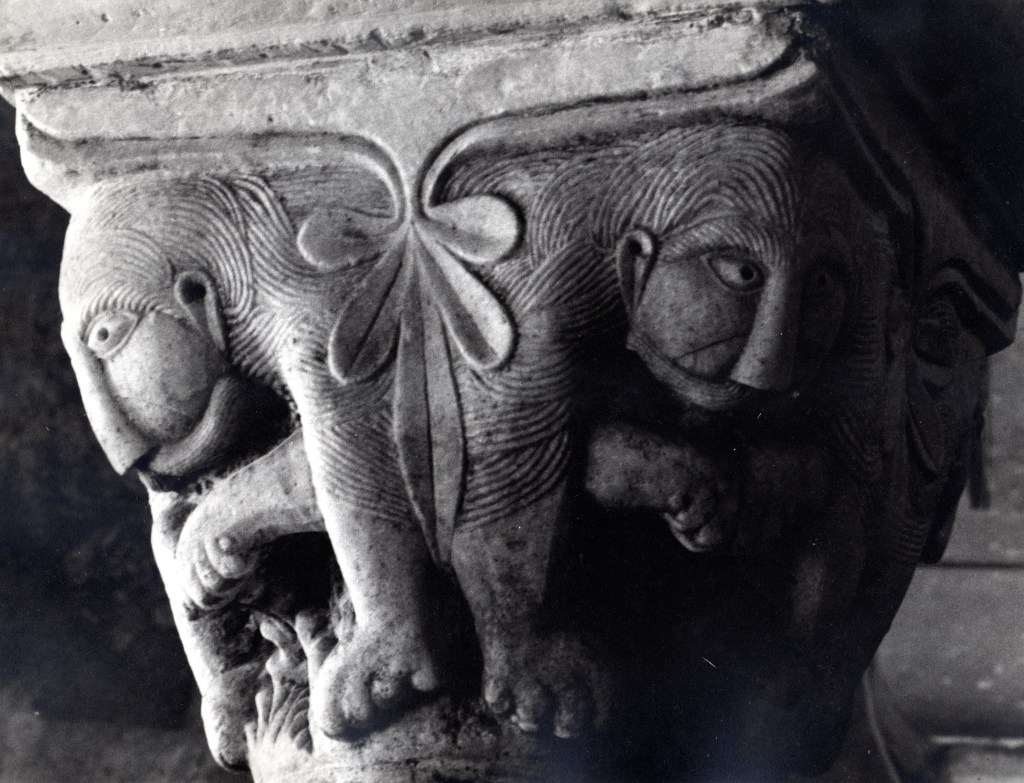
Mario’s descriptions of churches and the sculptures in the tympanum as we traveled through France brought the 12th and 13th centuries to life. When our bus stopped in a small town with a fine Romanesque church, he launched into a description of the façade, only to discover that we were in the wrong town and it was the wrong church. Romanesque facades did of course have much in common so it didn’t matter all that much. It was after all still Romanesque.
Adventures with him never stopped. When we arrived in Moissac, even though the church of Saint Pierre was closing, he insisted on entering. After being thrown out by the custodian, he told us that the interior wasn’t all that great anyway and that what really mattered was the portal with its sculpture of the twenty-four elders in the frieze, gazing up at the Lord. Which was quite true. And that was all we saw of the interior of Saint Pierre. Many years later the portal, with its façade, as well as the columns and porches on other churches, with their dragons and salamanders, harpies, dragopods, gryphons, and countless others which so frightened Adso, the novitiate, were to figure in Umberto Eco’s novel, The Name of the Rose and then were visually captured in the cinema version with Sean Connery as the Franciscan monk. I almost shouted out loud when they showed up on the screen, “Oh, my God! That’s the church in Moissac!”
Other adventures might include unusual foods or landladies (was it Corsica or Elba?) who tried to take advantage of the group, insisting that since the school had booked for students, she had thought it was perfectly OK to double them up in rooms with a double bed. Except the beds were what they called French beds, or three-quarter size, which created a problem when one of our students was anything but skinny. I had also been assigned a room with a nun and neither of us had any intention of sleeping together. We solved the problem by putting the mattress on the floor and one of us sleeping on that while the other slept on the bedsprings. Mario had been to say the least incandescent in remonstrating with the landlady who threatened to throw us all out. Even though I knew very little French, I succeeded in calming both sides down.
Our trip through Sardinia had its own high points. The bus driver was a master in maneuvering the bus along the narrow winding hilly roads. The highlight was Saccargia with a church in Tuscan style, of obvious Pisan influence, with alternating rows of black and white masonry. We were all sitting waiting for our dinner and the driver ordered a specialty of the area. When the cheese started walking along the table, you should have seen the haste with which the students moved to the other end. This cheese, known as casu martzu, contains living insect larva, and may now no longer be made. Although recently much has been made of eating insects to save the world, but in this case I wasn’t brave enough to try it.
Back in Tuscany we still had various churches to visit, with the one in Prato where the belt or girdle the Virgin Mary had given to Saint Thomas is kept and displayed five times a year. It is not chance that Prato is a textile town. I’m not sure though why the city can also boast a marble statue by Henry Moore, which to me, alas, looks like polysterene.
Back in Florence we all dutifully took the exam to make sure we had learned something and it was time for me to return to Orvieto, where the cathedral was more Gothic than Romanesque and my sons, in the care of their aunt, were waiting for me.
 Erika Bizzarri
What a wonderful little travelogue. I must rewatch The Name of the Rose! Your writing brings the students’ experience vividly into focus!! Sharing sleeping quarters with nuns! Shocking! I recall many nosy landladies from my early days traveling in Italy. Thanks!
LikeLike
Oh, my! These are colorful stories that I had not heard before. They brought back memories of my first trip to France in 1966 during what was known then as Junior Year Abroad. Fortunately, we never encountered “walking cheese full of live insect larvae!” I’m sure that with such an eccentric professor in charge, your indispensable services were well appreciated by the students. James and my church visits with you as our guide are unforgettable. I’d love to see your sketchbook and hear more about this adventure.—🧡from Diane
LikeLike
Erika-such vivid and detailed memories and you bring compassionate humor along with your tours-beautifully done! Thank you!
James
LikeLike
Such wonderful memories you have! I don’t like the sound of that cheese! I like to think that I can eat and enjoy almost anything that world can offer but living lavae inside cheese would be too much of a challenge. And why is it that landladies and landlords the world over can be so inflexible?? I suppose it illustrates why many religions insist that kindness to strangers is a matter of honour. And sometimes of course the kindness shown to travellers is truly astonishing.
LikeLike