One can also go from the so-called Villa to Orvieto by car.
Once upon a time
she lived in a stone house overlooking a valley. Almost every day she would cross over
to the town on the other side.
She might walk
down the cobblestone road
where in the past wagons
had rumbled, bearing
wheat and wine
and workers.
Or she might drive her
small white car
down to town along the highway.
There were those however
who insisted it was
not “down” but
“ up” to the town –
well, one did have to go down
and then up.
It was around fifty meters
from her house, known
locally as the villa.
She always drove carefully through the wrought-iron gate then along a dirt road with blackberry shrubs
and patches of great burdock leaves,
hiding burrs her dog would get entangled in.
Sky-blue chicory blossoms vied with
deep red poppies.
Age had rusted the gate,
bedizened mornings with dew diamonds
clinging to the spiderwebs. Photo gate
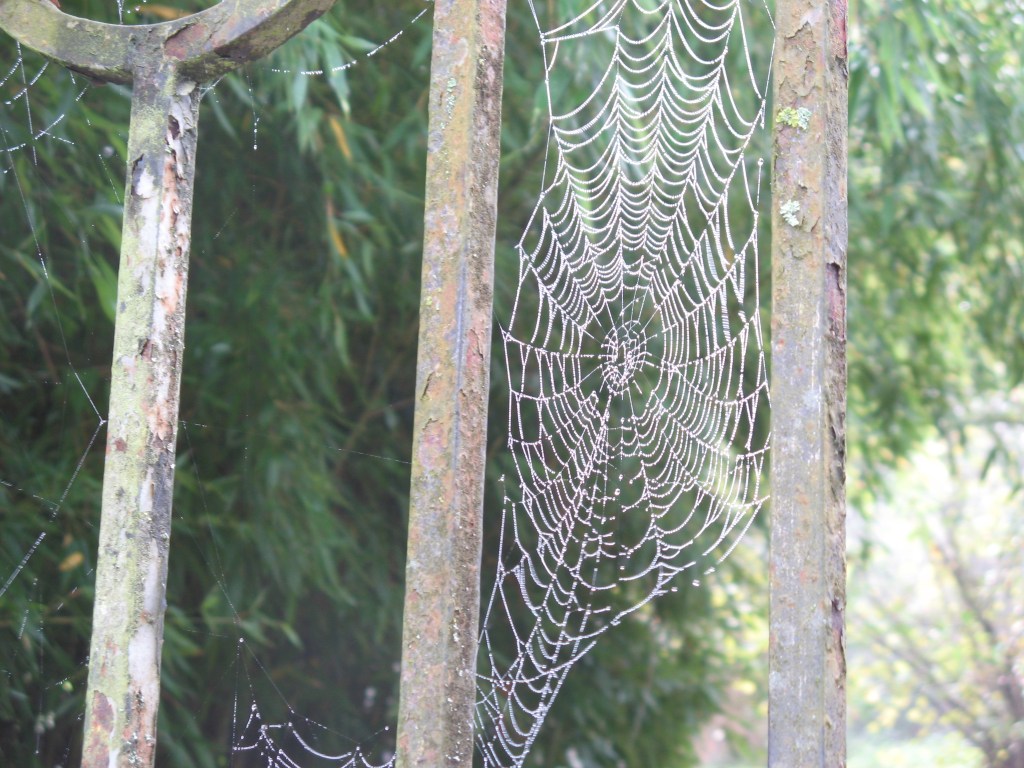
But then it had been soldered and painted
by the small man who trimmed her hedge,
a Romanian whose son was
now working in France.
His skills matched his loquacity.
If she returned at night
she might run into porcupines
ambling down the road.
Once it had even been a boar
trotting along as if he owned the place.
The reservoir for the city’s water
was on her left behind a padlocked gate. A sign on a crumbling house
read: House for sale.
A great location but in drastic need of restoration
One day when she had walked in to pick some figs, a snake
had slithered out of a crack in the stone wall.
A bit further on past the reservoir,
a chestnut tree clung to the slope,
A decrepit storage shed
was now a three-story house
with ivy looped in arches along a fence, disdained by her son as an exaggeration. There was a strawberry tree
across from where the dirt road
turned into a more civilized highway.
Symbol of the Italian flag.
Red fruit, white flowers, green leaves.
The group of houses further down
backed up against a hill
was where Lavinia lived.
The epitome of a contadina, a peasant,
stocky, someone you would never entrust with your precious porcelain dinnerware and whose help in the villa was limited to mopping the floors.
Despite her aristocratic Roman name,
she probably couldn’t read or write.
The neighbor’s mother might have been her twin, encountered every so often herding a dozen sheep, a cigaret hanging from the corner of her mouth, her hands busy knitting.
On the right a silver lace vine covered the railing. She had bought one on the farm and it had climbed, draped itself, over the garage. Vineyards, then olive trees, young, laden with fruit in November.
Orange nets were lying in wait
ready to be stretched underneath
for the harvest.
It was a road where things might happen. Same could be said of life.
Who knew what was waiting around the corner. Like the day it was raining and two golden spaniels, dripping wet, were running along the road.
She passed them, changed her mind,
turned the car around
and would have taken them in
even though she didn’t know
if the dog she had at home
would have been amenable.
However when a bit further up
they got to the house set back from the road,
the two ran through the gate
and probably lived there.
At least she hoped they did.
Problem solved.
The house at the next curve
had recently been restored.
She had never seen the owners but
there was a wisteria vine over the entrance.
Just across was a lookout
where cars would pull up
to take their classic shot of that city
“high and strange”.
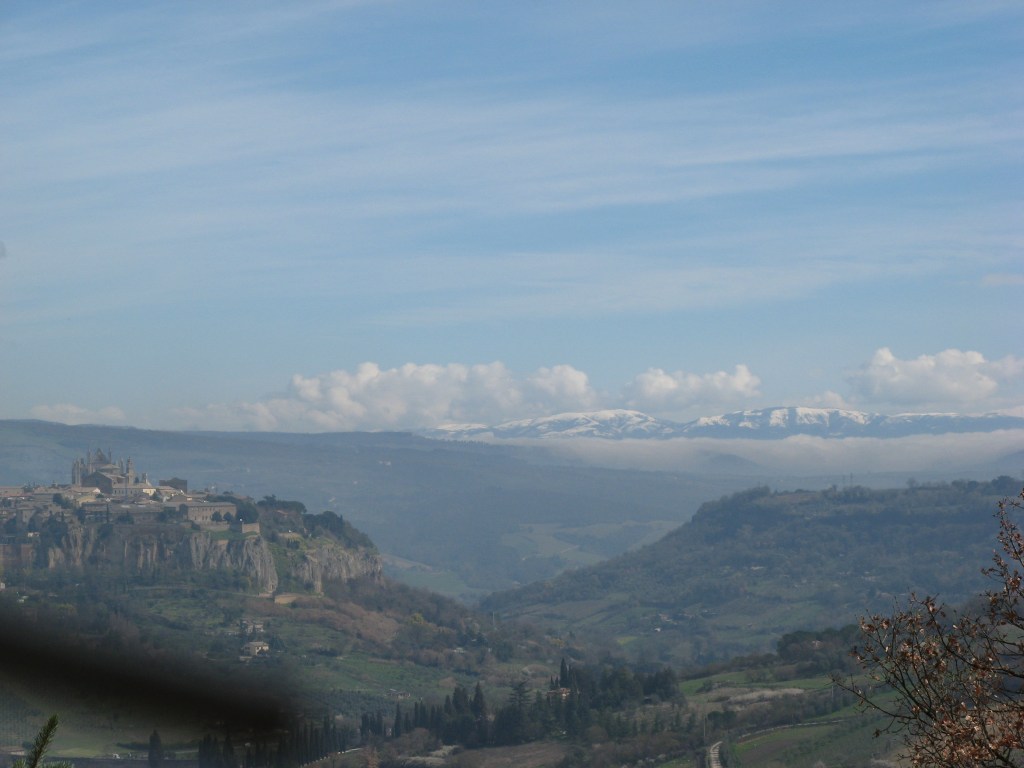
On the other side a long hedge of
miniature roses in various shades of pink and red, ran along up to a gate
that led to a large stone tower house
and had a swimming pool.
Bought, she thought, from a jeweler
who had been a priest
to fulfill a vow made by his mother.
He subsequently married
and hopefully lived a happier life.
As a jeweler he had repaired
a nineteenth-century traveling clock,
breaking one of the teeth on the gears.
Then he had also ruined one of her grandmother’s earrings, made, as was the 19th-century custom, with a braided net of her hair,
when he tried to solder the clip.
There were more olives on either side the road,
and a side road led off to the left
where one could occasionally see horses,
or a red sign warning people that a boar hunt
was in the offing.
The fortress-like additions to the cemetery soon came into sight. She had never like them,
and later learned that they had been an early
work by the renowned architect Fuksas,
who was inspired by local materials,
such as tufo, as well as clouds.
The small black and white photographs on the tombs, so like condominiums,
reveal the humble origins of the inhabitants,
the men in proper jackets and ties.
She sometimes liked to wander there and imagine what their lives had been like.
The tombs of the nobility
were marked by small shrines or chapels.
As the Day of the Dead approached
the florist would display
gold and russet chrysanthemums,
to be set on the graves together with the candles.
The small piazza right outside
was where the cops
often lay in wait for cars so they could
check the headlights and insurance documents.
Generally when they saw the driver was
only an elderly gray-haired lady
they wave her on.
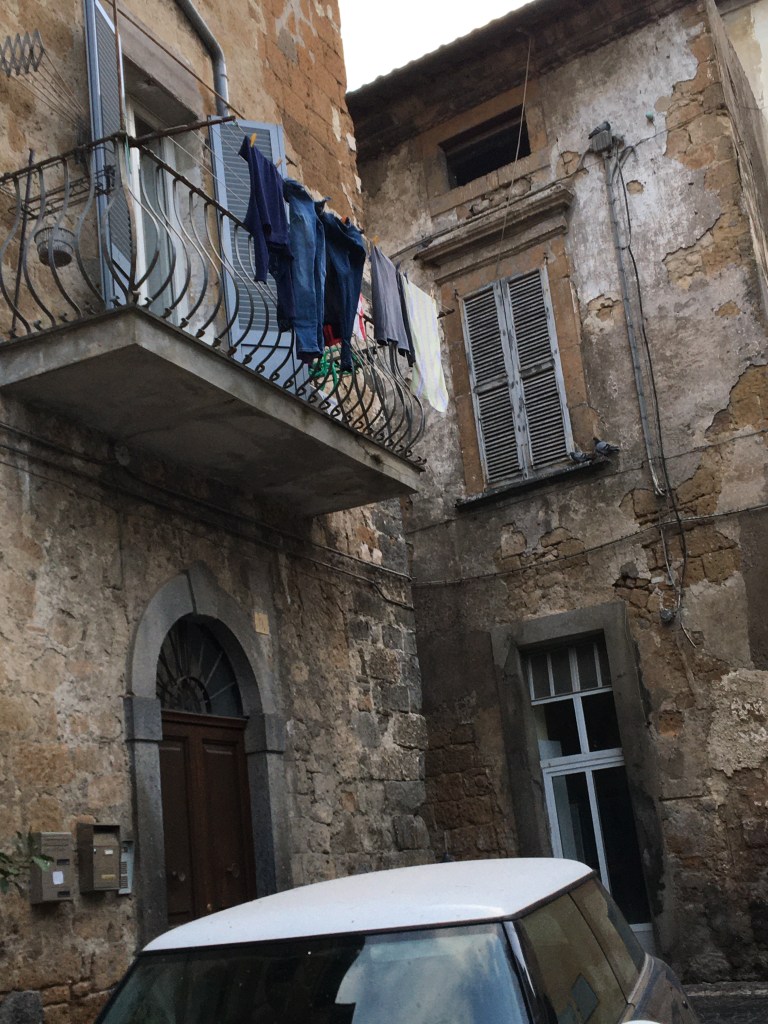
Further down on the right a cluster of houses
with simple unplastered stone facades.
She had always thought the one
with a pair of black trousers and a work shirt hanging from the balcony
would have made a good painting.
The bar. Of course there was always a bar,
a coffee bar, a gathering point for people waiting for the bus or just stopping for a cup of coffee.
In summer it was where the students participating in the archaeological dig would hang out.
The name? Bar Obelix.
Who knows who first gave it that name
Asì well as that of its sister or a brother bar,
Bar Asterix, in a neighboring town.
A bridge, although there no longer was a river flowing underneath, had an unfortunately modern church to one side.
The locals had not been asked and thought
the old church down in the hollow
could have been restored.
That was now where you could leave
clothing for the needy.
At the roundabout a small dog
could often be seen waiting patiently at the pedestrian crossing
for the cars to stop and let her cross.
From here the road was all uphill, with linden trees lining the road.
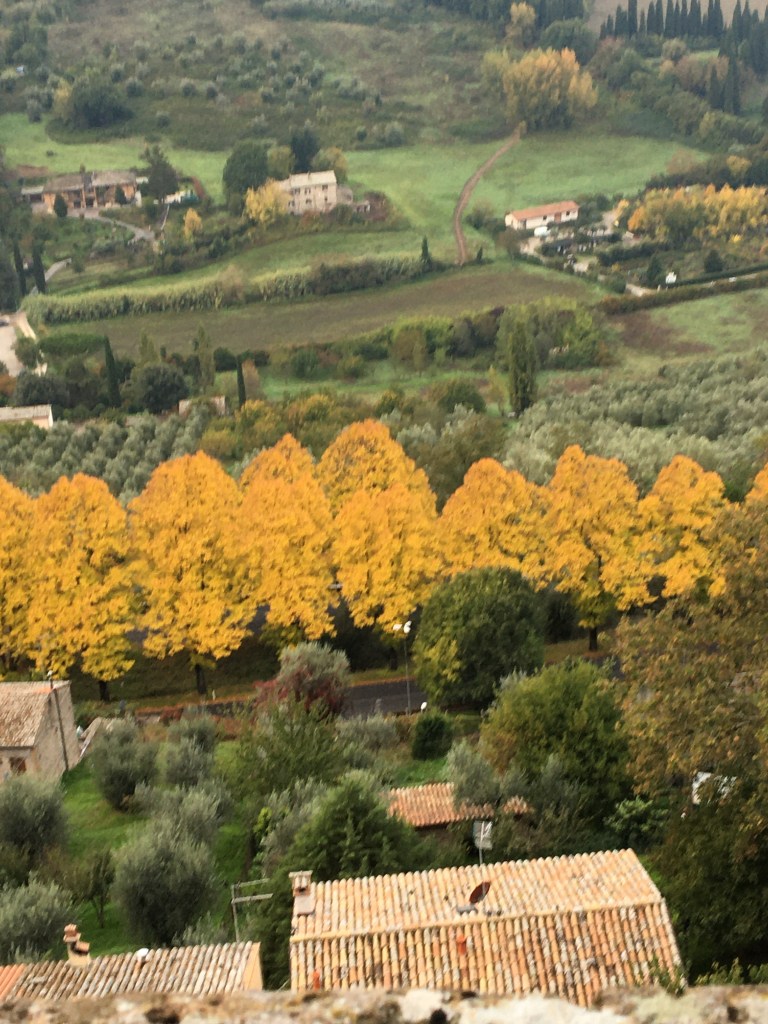
Halfway up, before the large parking place,
a mimosa was always among the first to flaunt its yellow blossoms, supposedly the symbol of woman’s day.
She loved the linden trees most though,
whose heavy fragrance was synonymous with June
but whose russet crowns later presaged autumn.
She drove into the parking level, looking for
the batch of downy nestlings in an unused parking light.

 Erika Bizzarri
Beautiful description, Erika – of a journey ‘up and down’ to town taken by an anonymous gray-haired elderly lady who clearly loves dogs, would pay her respects to wild boar and knows exactly where to find a squash-up of baby birds!
LikeLike
Delightful tour that matched my cherished memories of that beloved route.
Thank you carissima Erika,
jhan from Bisbee Arizona
LikeLike
I do love this one—especially the ending where the enterprising birds have made a cozy home by brilliantly repurposing an abandoned traffic light no longer lighting up anything. How did that “batch of nestlings” know their timing would be so perfect, as this bird lover heads back to her other home? I wonder if generations of the same family return regularly like the sparrows that used to nest above the porch pillars of my childhood home. As kids we used to love watching them from a safe distance. Or maybe it was the other way around?
The colors and language are lovely and very “Erika”:
Sky-blue chicory blossoms vied with deep red poppies
a Romanian…whose skills matched his loquacity
Porcupines amble
a boar trots along “as if he owned the place”
russet crowns that “later presaged autumn”
“A boar hunt was in the offing”
“Vineyards, then olive trees, young, laden with fruit in November”
The whole life cycle is here. Grazie from Diane, your fan for all seasons. 🩷
LikeLike
A colourful tapestry of words lovingly told – evoking and awakening memories of the road
I also have walked – not as frequently as you- several years ago.
Abbracci e grazie per le memorie. Csaba
LikeLike
Thank you…
LikeLike
Your writing enables me to feel close even though I am far from Orvieto now.
LikeLike