Camilleri. Thanks to Camilleri, his police inspector Montalbano and the small Sicilian town of Vigàta have become what might be called household words. Albeit the town so familiar to the devotees of the mystery series shown on television is a collage of various Sicilian towns, there is no real town by that name. Although Camilleri is best known for his mystery novels, he turns out to have been a surprisingly multifaceted figure, a stage director and playwright among other things. His writing is marked by an acute analysis of character and a realism in his settings and landscapes, using a language that, except for when he takes off into dialect, might be called homey or homely in the British sense of being unsophisticated. In his frank approach to his Sicily and its defects, Camilleri uses an every day sort of language, where you don’t have to delve into abstruse meanings.
So here I was sitting on one of the blue plastic chairs at the Blue Bar. They were certainly more comfortable than the metal ones outside which leave marks on your derriere if you sit on them as much as fifteen minutes. There was a lull in business, a pause between the morning cappuccino and the afternoon espresso, the normal pick me up. Antonny, the barista, grabbed the book we had been using to help him improve his English and joined me. Isn’t it time to read something more, by myself? he ventured. It hadn’t occurred to me, but a different approach to a different vocabulary might be called for. A classic author writing in English might be best but those I could think of, like Dickenson or Virginia Woolf, Hemingway or Faulkner, were dated in their approach to the society of the time. Something for children? The Cat in the Hat? Not a bad idea but it would probably work better as a book to read to his children. The Wind in the Willows? On the first page I find several words for more or less the same thing: scraped and scratched and scrabbled and scrooged. Translating them into Italian would be a real challenge. And the Mole’s environment certainly was not one with words Antonny might use every day.
Then Camilleri popped into my mind. And his Montalbano series. Yes, true they had been written in Italian, including a Sicilian dialect Camilleri had in part invented. But they had been translated into English. I had bought one to see how the translator had dealt with the problems involved. He had Montalbano and his crew speak ordinary English, while Catarella, whose Italian was practically impossible to understand – at least as Italian – , was a dilemma that had to be solved on its own. And I must say the translator did a pretty good job.
We might give one of the Montalbano series a try – at least it’s not set in another century. I had, so to say, hit the nail on the head. I had a paperback of The Voice of the Violin. The language was fairly ordinary, with the exception of references to forensics and squad cars, and the descriptions of places was realistic but not overly poetic. There was a plot. It unraveled gradually and you always wanted to know what happened next. Perfect. Since it was a paperback, I gave it to Antonny to do with what he wanted, underlining words to be explained, marking the syllable to be accented and where he was to come to a full stop.
So, my choice was The Voice of the Violin.
Antonny was thrilled and we began a new adventure. New words, new idioms. Although I had to keep reminding him to keep his eye on that final “s”. After we had gone over a page or two together, I went home, hoping to get there before it rained. While I took a quick walk with the dog to stretch my legs and hers, Antonny, in between making the next espresso or spritz or glass of wine, continued reading. I knew that the following day he would go over what we had done today, and tell me how far he had gotten, repeating new words and using them in a sentence.
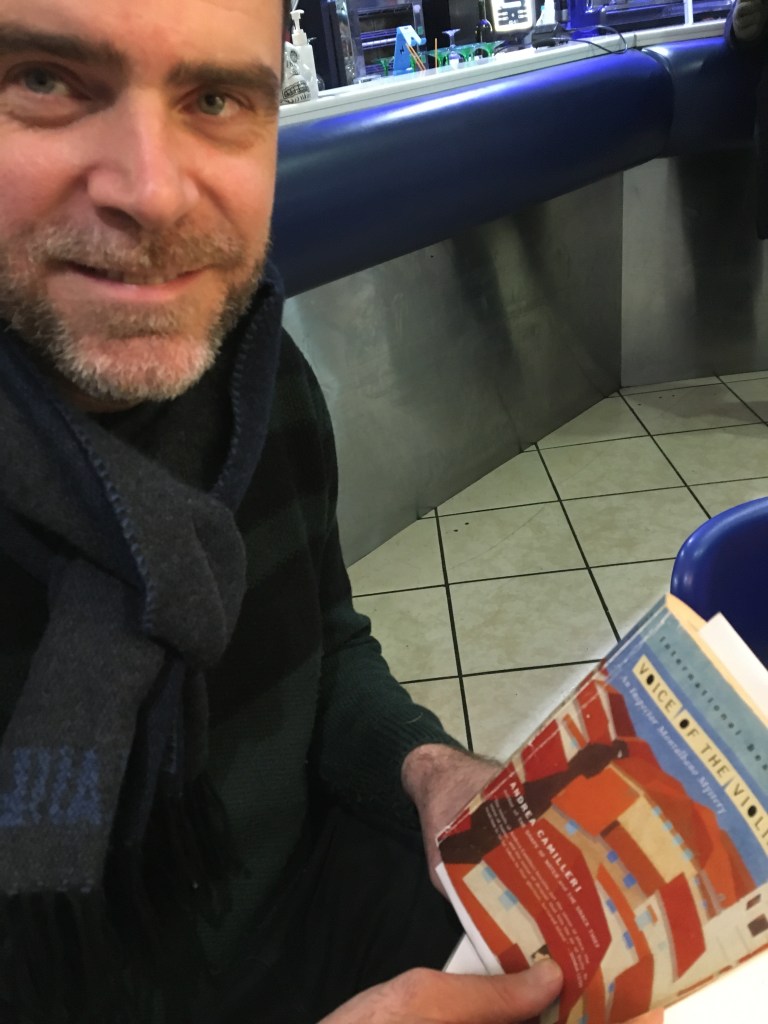
If only, I thought, if only students would learn to do without their phones and approach the challenge of learning with such enthusiasm and delight. How privileged I was to be able to help a bright human being discover the world of words around him.
 Erika Bizzarri
Wh
LikeLike
You are so incredibly thoughtful, dear Erika! Reading Camilleri’s novels translated into English is a great idea. The gift you are giving Antonny is priceless! And he loves and admires you for it, as do I.
LikeLike
“Anonymous” is Ernie
LikeLike
I regret to say that I don’t know Camilleri’s novels – I must look out for them. And, like Antonny, I seem to have much to learn from you, Erika.
Your anecdote reminds me of something. Early in my adult life, when I was trying to improve my French by reading short stories in French, and then novellas or novels without too many pages!, I came across an Agatha Christie novel translated into French, and read that. It worked.
LikeLike
How privileged you are Antonny’s patron…what might I read is I am working on my Italian?
LikeLike
I love that you are sharing Montalbano with Antonny in English. I love those books and have read several in Italian and one or two in translation. A great writer and a great contribution to Antonny’s knowledge of both southern Italian and English translation!
LikeLike