Objects have souls and stories of their own.
In 1794 when he was confined to his room, Xvier de Maistre wiled away the time by entering into conversations with those not so mute objects he encountered..
And in1933, Louise Bogan also undertook a journey round her room.
Since I have no intention of writing a book and this is just a post, I can limit myself to scrutinizing the four objects on the dresser that leads to the bedroom.
A bowl, a flaring green glass vase, a paunchy two-handled vase for flowers, and a round wooden box sit next to each other. Each one has, what I might call, a soul of its own. None are impersonal objects. None would mean the same to anyone else. What they denote to the observer depends on the observer more than on the object itself.
Four objects. The tall open-mouthed bowl with an allover pattern of sprigs of leaves climbing up the sides couldn’t be anything but Swedish. It was given to me by a friend from Australia who then lived in a house across the valley from Orvieto. She had spent time in Benghazi where her husband worked for a Swedish firm. The bowl was a cachepot for the plant it held.

The plant eventually died or maybe I had transferred it to a more permanent site in the ground. It makes me think of how I used to help prepare textile designs when I was in NY, when a pattern had to be drawn and painted so there would be what they called a repeat, with the end matching the beginning, then to be transferred to a roller, turning it into a sort of endless pattern. Now obviously, to judge from the great variety of colored prints, large flowers scattered here and there, tiny triangular fish-like shapes, everything imaginable that women are wearing, things are done differently. What was the plant in that bowl? What were some of the textile designs I helped make repeats for? The plant has gone the way of most house plants. One could perhaps still find a textile in a remnant store dating back to the old techniques. One I remember was a sort of tapestry design with lines connecting various dancing figures. I had helped make the repeats for Al, who had been my first contact in NY. We had met on the train as I was returning home after my year in Mexico and he from a vacation. He had offered me dinner, and a drink, but as we were going through a dry state, no cocktails were permitted. A sweet man, more mature compared to my twenty odd years, an artist as well as textile designer, who introduced me to NY and Greek and Italian cuisine, to Indian music and dance.
Then there is the flaring rather heavy green glass vase. Probably bought with my husband Mario when we went with a friend, another Mario, to Lucca. Perfect for roses or a branch of peach blossoms. When a friend of mine was writing her “Letters to Men of Letters,” she needed an illustration for Kafka so I put roses and the vase and a letter together in a composition for her, although she didn’t use it.
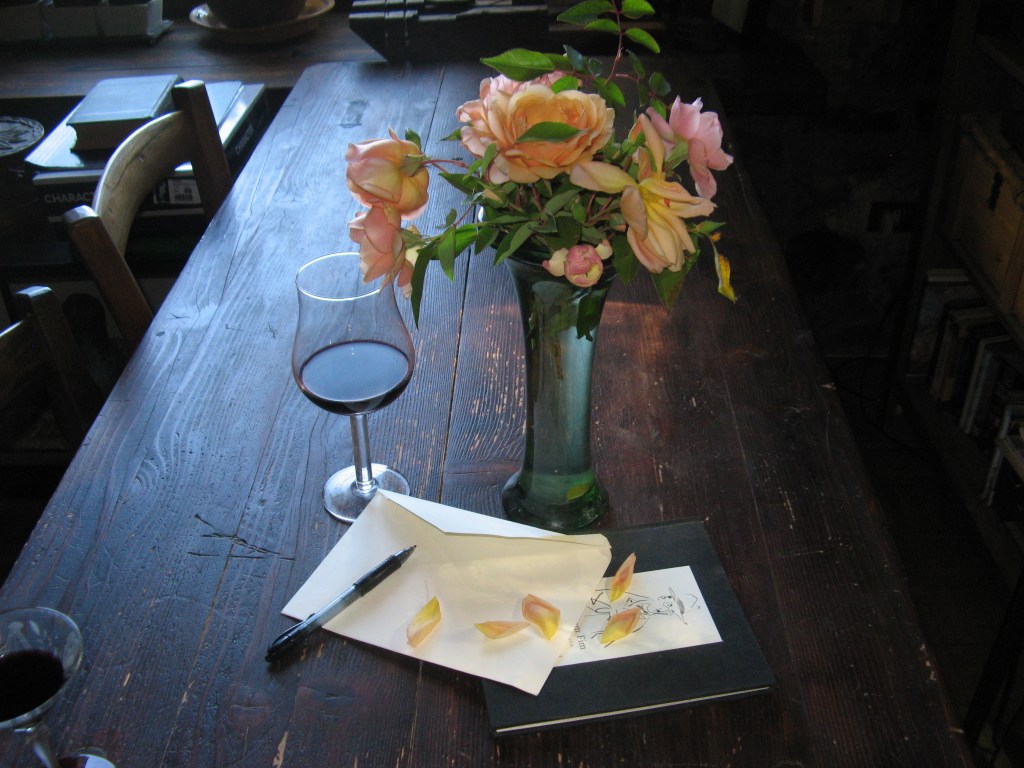
The vase didn’t hold much water though – and that too could become a point to ponder. A vessel is meant to hold something, it’s a container. We too are meant to hold or to contain . . . what? Generally a liquid, in the case of the glass, or for human beings, we might even say a soul. And I guess some of us have little room and the souls we contain are very little, very small.
The two-handled earthenware vase, rather pot-bellied is the right word, with greenish grey glaze, sand-colored at the bottom, had been my mother’s and crossed the ocean at least twice with her. Again, perfect for tulips or flowering apple branches. Apple branches. When I was a girl, maybe 8th grade and living on the farm, I brought a big armful of apple blossoms to my teacher, on whom I had a crush. Most of the kids didn’t like her. She’s the only one whose name I now remember. Miss McCormick. She introduced me to Shakespeare. Once I also brought her a kitten. Wonder what she did with it.
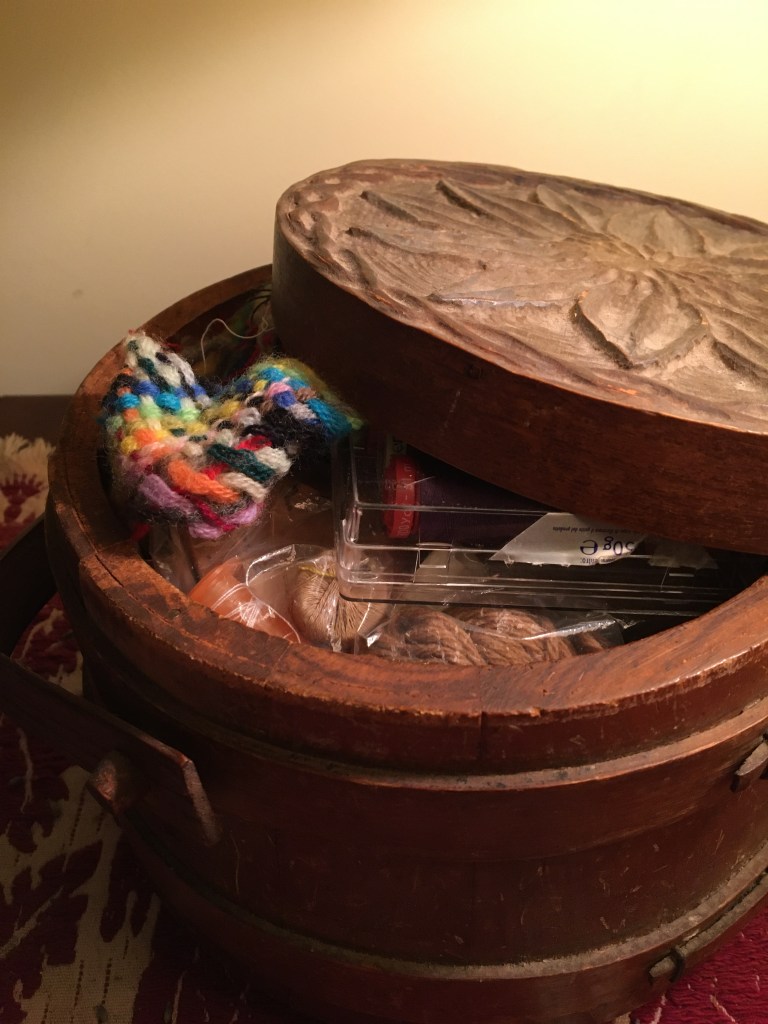
Then there is a round wooden box with a geometric design carved on the lid. Made by my father. The box now holds sewing material, threads and buttons and needles. An awl used by my father probably to mend some kind of net. A braid of multicolored threads, from years and years ago, but still useful when seeking just the right color for a mend. Small containers of buttons, which no one will ever use. Still, here in the apartment that sewing box has shown itself to be particularly useful.
There is actually a fifth object over to one side, a photo of a morning glory vine printed out by my cousin Tommy last year and nicely framed. I had taken it years before for my special friend Nennella, with a real camera. I had gone to her home in the morning when the light would have been right. Aside from her roses, she loved her heavenly blue morning glories and I had brought her seeds from the States. Although the color when printed never came out as gloriously blue as it should have been, I loved the composition.

So by itself what you see can often be very mundane, but that’s not what matters, for there’s always more to an object than appears. It’s the stories they have to tell! And how many more they could tell!
 Erika Bizzarri
❤️ You bring like a magician the inanimate to life!
LikeLike
Cara, what lovely memories your reflections stir – recall the nursery, plant shop and gardening centre – at Taby. We were wandering around as Kay enjoys looking and identifying plants and then we saw THE FLOWER POT — and the rest is history as they say. Planning garden renovations, Australian flora for the new house. Abbracci.
LikeLike
Cara, what lovely memories your reflections stir – recall the nursery, plant shop and gardening centre – at Taby. We were wandering around as Kay enjoys looking and identifying plants and then we saw THE FLOWER POT — and the rest is history as they say. Planning garden renovations, Australian flora for the new house. Abbracci.
LikeLike
I must ask my teacher daughter, who is in New Zealand, what she would do if a pupil brought her a kitten! They have recently acquired two kittens but I’m pretty sure they were not gifts from a young admirer!
LikeLike