One reads every day of the amazing courage of those who are fleeing Afghanistan, Ukraine, and other countries that are repressive or torn apart by war.
Yet in their own way, for their time and place, the women who were my ancestors were also amazing.
I cannot help but wonder what induced a young woman of a good upper middle-class family schooled in literature and the classics to leave a comfortable home and venture across not one but two oceans.
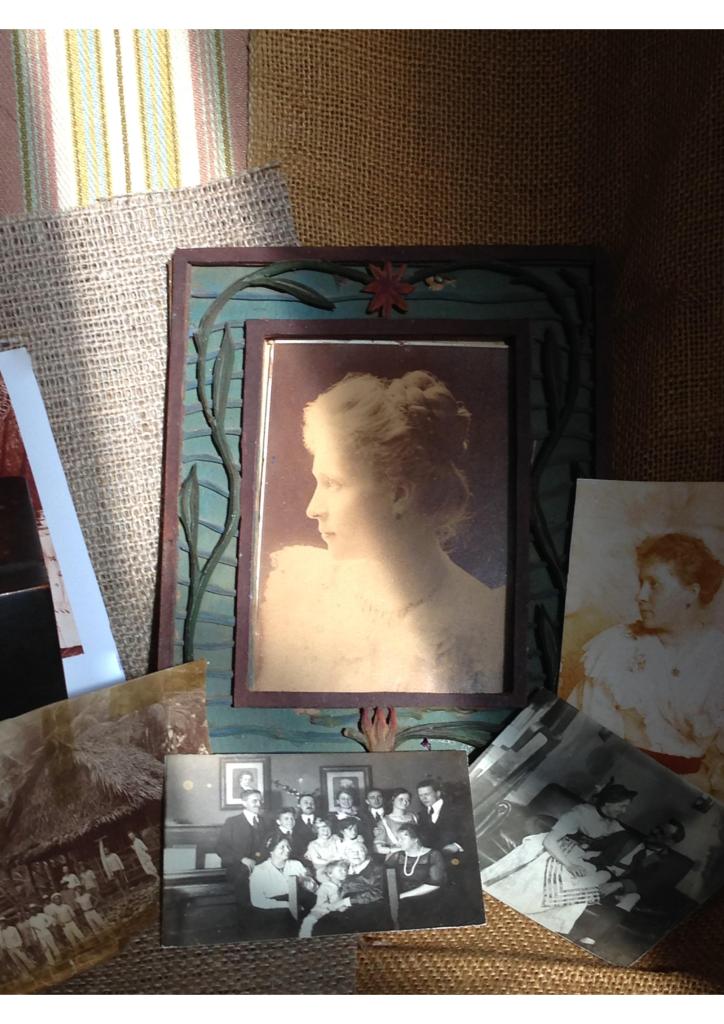
Eugenie (Jenny) Voetter
1876 – 1936
“1899. I was 23, a concert pianist and a soprano, when I sat for my portrait in Munich. In a year I would have my firstborn child, on a forlorn island in the Pacific where I had followed the man with whom I had fallen in love. And where a dark-skinned native asked me to “fightem bockes belong cry”, his definition of a piano. Before the year was out, together with my infant son we crossed the great ocean again to join my brother on the American continent where a foreign country called United States became my home and where I bore my husband three more children.”
The women, then as now, rarely went just by themselves, for their children were part of who they were. Leaving their children alone would have been unthinkable. Even if their children were already adults.

Elisa Appel Voetter
Koburg, 1841 – Peterson, N.Y. ,1927
“Here I am, 80 odd years old, toasting you with a glass of wine, framed by my beautifully embroidered handkerchiefs, my copybooks in perfect Kurrit script, French – Don Carlos, German – the months, all relics of my education in Nurnberg as a girl in the 1850s, the daughter of a well-to-do technical instructor. No one then would have guessed what my future life would be like.
In 1899 when I was almost 60, my future son-in-law went to Ponape, an island in the Pacific, where he was to build roads and bridges for this German colony. He persuaded my younger daughter Jenny (his fiancée) to go with him and of course her older sister, Linchen, and I could not let her go alone. I still don’t know how he talked us all into it. When we arrived after a seemingly endless journey, we first lived in the governor’s house and then in a smaller straw-thatched one where my grandson was born.

I was certainly not used to seeing the natives going around practically naked. Once there was a revolt and Linchen kept watch at night with a rifle cocked under her arm. There were great cockroaches and little geckos that had the habit of falling from the ceiling into one’s soup. The climate did not agree with my daughter, and in 1900 we once more boarded a steamship and from Australia went to San Francisco. A three-day trip by rail then took us to Brooklyn where my son Max had already set up a business. We were finally back in civilization! Once more, a new beginning, this time in the United States.”

One can also make conjectures about the men they followed.
Men who were sent by their governments, men seeking to make a fortune, men who fled their governments. Men who fought against their governments.
Perhaps at the time it was normal that a man should seek his fortune elsewhere. Take my grandfather, Jenny’s husband. Perhaps he saw no future, perhaps he hoped for one of those sure government jobs, and accepted the offer of the German government to go to the Caroline Islands in the Pacific in what was at the time a German colony, to build roads and bridges.
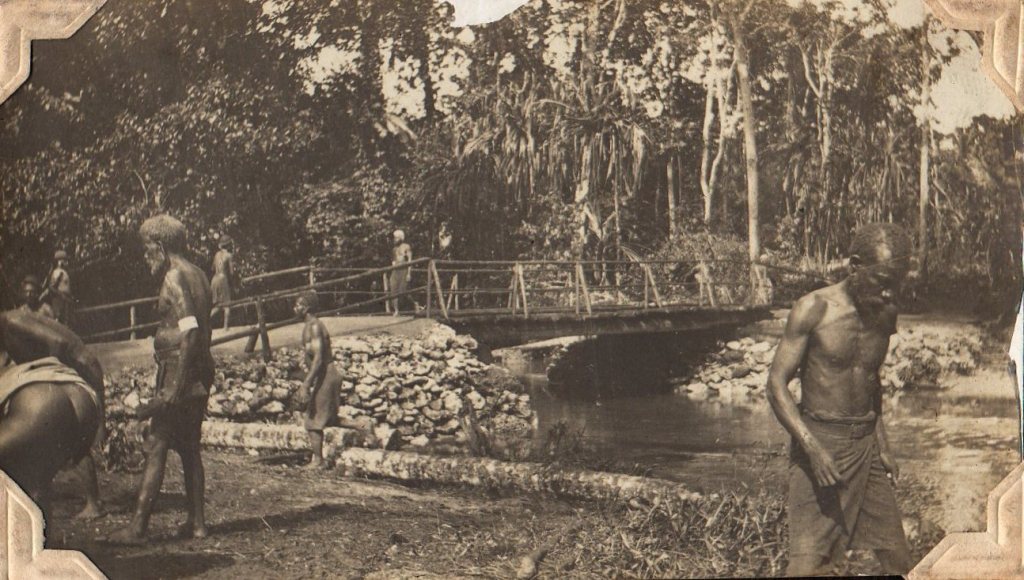
How much did he know of the place he was going to? Surely, he must have had an idea when he persuaded his future wife and mother-in-law and sister-in-law. to come with him.
Here he and Jenny are with other members of the group of Europeans who settled in Ponape in the Caroline Islands: planters, overseers and “bringers of civilization”. He is the fourth from the left.

Certainly, when he finally returned to “civilization” and New Jersey where his wife and child had preceded him and where her brother had previously settled, he undertook a variety of professions, for it was evidently not all that easy to find something in his field. The list he gives in a sort of autobiography makes me smile: engineer, singer, magnetic healer, colonial surveyer, carpenter, machinist, factory overseer, auctioneer, owner of stables, printer.
 Erika Bizzarri
What a fantastic voyage, what a fantastic family, history of adventure and purpose. Reads like something from the Swiss family Robinson era. but I have seen the artifacts, masks on your wall that they brought back —it’s more incredible because it is true.
Love that you can tell the tale that so many other families might have lost along way to the future. ❤️James.
LikeLike
Such an extraordinary record to have in your family – and no doubt you have more.
It’s good that you are adding your own account to the family archives!
LikeLike
I had heard a few snippets from this fascinating family history and seen some photographs, but thank you for this chronology. Travel is in your genes!
LikeLike