Hidden churches, saints in small side chapels blessing the city. Steep streets – well, there’s really only one in this town – where the farmers who came to market with their donkeys tied them up and then had fried cod washed down with a glass of Orvieto wine before returning home. There is only one place here now where you can have a midday meal, but it probably won’t be fried cod. Otherwise, you’ll have to return for the local saint’s day when the ladies make their fried fritters, to be sprinkled with salt or sugar. Aside from St. Patrick’s well at the other end of town, there’s a really deep well here too. If you look carefully you can see the footholds made by the Etruscans when they first made a shaft in their endeavor to get down to the water table. If you go further down Via della Cava you’ll see the entrance to what used to be the Etruscan defenses. And look, over the gateway of Porta Maggiore, there’s a statue of a pope. That’s Pope Boniface VIII, who was accused of idolatry by putting himself where some say he should have put a saint. Imagine a later pope, Clement VII, riding up on a mule in disguise after the sack of Rome and taking refuge here in Orvieto.
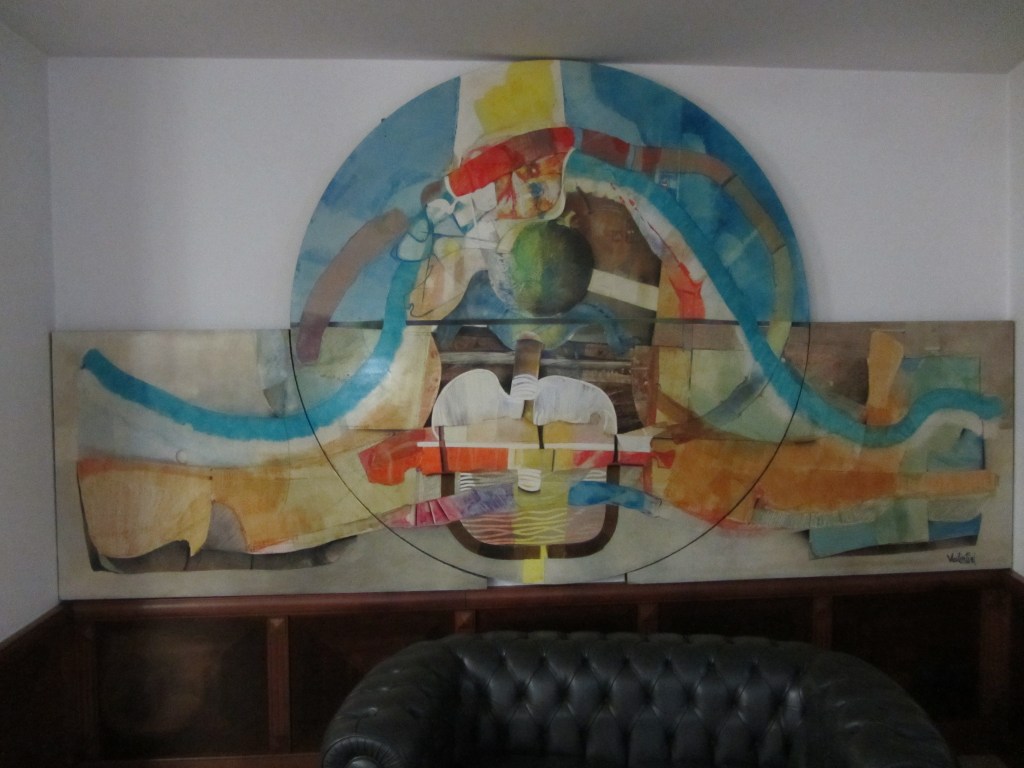
The sun has warmed up this side of the cliff as you start your trek on the ring road that circles the whole cliff about halfway down the side. At the entrance there’s a plaque to Livio Orazio Valentini (such a classical name!), an artist who became renowned above all in Aiken in the United States. True, you think, a prophet is never recognized in his homeland for he’s not in my art history book. Continuing your walk, you can look down on the Etruscan tombs, you can delight in the roses planted in honor of Reno Montanucci who suddenly left his earthly life right here and whose cafe bar in the town must still have his spirit hovering over it.
If you do the whole ring walk, you may end up at the parking lot. You can take the elevator or the escalator that tunnels through the rock on which the city stands to end up on Ripa Medici from where you can look down on the valley and almost touch the clusters of unassuming whitish green blossoms of the trees that reach almost up to where you are. That fragrance that fills the air, if it’s early June, is from the linden blossoms. Before that it was jasmine enveloping doorways and windows. There’s the city gate with an occasional car going through. Porta Romana it’s called but that only means it’s on the road that leads to Rome and certainly wasn’t built in Etruscan or Roman times. It’s crowned by the imperial eagle and a goose, in honor of the geese who warned the citizens of the arrival of the Gauls. With a full moon hanging low in the sky, the view as it rises up behind the gate is truly breath-taking.

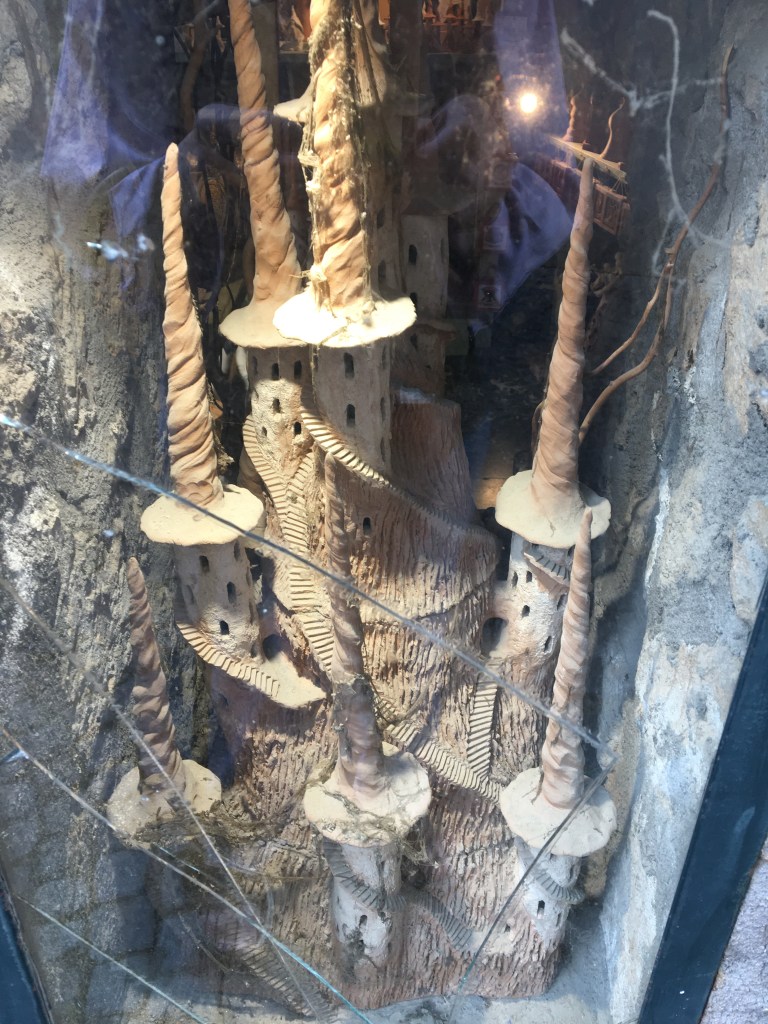
It’s already another day. How time passes. You’ve discovered another lane leading back into town and you watch Alberto, known for his dwarfs and dancing couples, turning a blob of clay into a miniature group of medieval houses.
Someone coming out the escalator entrance (or exit) two doors down asks which way to the market. The market? Right, it’s Thursday and you hadn’t even known it was market day. But maybe today you don’t have time and you need to sit down somewhere and have another cup of coffee or glass of prosecco and chat with the other clients. The market can wait. By this time, you’re convinced that one day certainly isn’t enough. And not even a week. You haven’t even peeked in some of the hidden courtyards or churches to see what saints are supposed to be watching over the city.
And then you realize you’re not alone and thank the myriads of masons, soldiers, and Grand Tour travelers of the past for having let you see their world as it was then.
 Erika Bizzarri
You make an excellent tour guide Erika: I can almost see those steps in the Etruscan well and hear the geese as the Gauls approach!
LikeLike
Erika you have an amazing vision which you translate beautifully into words. Each description brings back into my memory my previous journeys in and around Orvieto. As John said above, you do make a good tour guide, and in fact, you have written an excellent Tour Guide book, which I read prior to my first visit there: “Orvieto as it Was… and Is”.
LikeLike
Such a lovely tour of lovely Orvieto!
James
LikeLike
Erika, thank you for sharing your truly unique perspective on Orvieto. I met you (as did my wife) in May at the Blue Bar. We chatted for a few minutes and you signed your book, which I have now read twice. We return in September to set up housekeeping in our new apartment in Via Della Cava, and look forward to seeing you then….perhaps at the Blue Bar or Bar Montanucci.
LikeLike
This piece reminds me of the evocative old-time photographs of Orvieto that I’ve enjoyed studying on the walls of Cecilia’s excellent restaurant, Antica Cantina l’Osteria delle Donne. We don’t walk the Rupe as often as we’d like, but you’ve given an extra incentive by mentioning the roses dedicated to the memory of Montanucci and the Valentini plaque.
I especially like your last paragraph where you bring this cycle of life full circle:
“And then you realize you’re not alone and thank the myriads of masons, soldiers, and Grand Tour travelers of the past for having let you see their world as it was then.” Only in our 15th year here, we like learning about the past of our adopted city. We’re grateful that Orvieto found us!
LikeLike