As you and the bus on its way back down to the funicular cross paths, the black and white striped cathedral rise up silhouetted against the sky. After studying the gold and colored mosaics and the sculptures on the facade that promise redemption or the tortures of hell, you cross over to the Corso, one of the other streets leading up from the funicular, and amble down on the lookout for a place to have your lunch. The ever-changing shop displays are as colorful as the flowers, often petunias or geraniums, set outside some of the houses in the side streets. Wouldn’t it be nice to swirl that bright red scarf around your neck, or greet summer wearing that blouse or shirt with its small flowers or geometrical designs? You wonder how these small shops can survive as you study the offerings of the restaurants, including a surprising sushi place with all you can eat on the luncheon menu. Or the many small “holes in the wall” which advertise fresh homemade pasta or roast porchetta.


A panino with porchetta and a glass of wine will be quite enough for now as you wonder whether your 18th century forbears would have preferred a more substantial lunch, although they probably would have waited till dinner. In his Pictures from Italy, 1864, Charles Dickens accepted what the inn had to offer, in particular if it was accompanied by Orvieto wine. “Stewed pigeon, a bit of roast beef, and a scrap of Parmesan cheese, and five little withered apples, all huddled together on a small plate, and crowding one upon the other, as if each were trying to save itself from the chance of being eaten.”
You decide to ignore the shop windows on the Corso as you wander along a lane that moves off at one side. Details begin to call attention to themselves – and to the past. The honey-colored tufa rock makes you wish you had brought along your watercolors. Over there on your right, there’s an arch that launches itself over the street from a small church to a noble palace across the way, a gallery so that the owners could go to mass without being obliged to cross over in the rain to get to the church. Those grooves along the walls of the narrow street leading to the edge of the cliff – they’re from the carts that scraped them in passing through.

Don’t forget to raise your eyes occasionally –there are aborted arches in the walls that have been replaced by more “modern” windows, some with checkered decorations. The architects must have thought someone would appreciate the rich cornices under the eaves or at least they would have amused themselves adding masks and curlicues to the top of the pilasters framing the doors. Your meanderings, since you’ve decided that one day isn’t enough to get to see the town, might also take you to the Confaloniera on the other side of the cliff, where you look down on the highway and the railroad heading up to Florence.
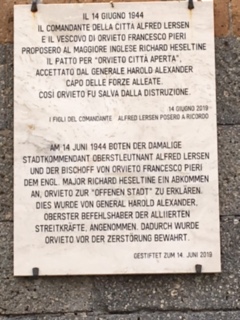
Here and there plaques call your attention to things that happened, to people who are remembered now for what they once did or meant. There’s one to Erminia Frezzolini. You had never heard of her but find she was a soprano beloved by Verdi for her interpretations of his music. The small grey plaque on the Corso tells you where Freud once stayed overnight. He based one of his psychoanalytical theories on the fact that later he could not remember the name of Signorelli, the artist who painted the end of the world in the cathedral. Over by the cathedral square is a plaque commemorating the German general and the bishop of the cathedral, thanks to whom Orvieto became an open city in June of 1944 and was saved from destruction. The British major Heseltine, the first of the allies to arrive, who intercepted the German proposal as he looked down on Orvieto from the heights, is also remembered. If you don’t wander around the city on foot, you’ll miss all these.
 Erika Bizzarri
Dear Erika, I enjoyed this piece a lot. I will be your neighbour again in a couple of weeks time,
Mark.
LikeLike
Dear Erika;
Thank you for pointing out to me some of these historical plaques during my recent visit in Orvieto.
LikeLike
I love all of this post, but especially the way you have phrased “people who are remembered now for what they once did or meant.” By recording and writing as you do, you remain the best company a visitor to our city could have. Grazie! 🩷
LikeLike
Reading this, Erika, I feel that I have enjoyed meandering around town with you! And thank heaven the town was spared from bombardment.
LikeLike