What shall I write today? It is already Tuesday.
Perhaps about Judi Dench and Shakespeare since I’m reading Judi Dench the Man Who Pays the Rent. Each night four or five pages of bedtime reading, no more. Of marveling how Judi analyses each of the characters she then brings to life on the stage. How she inhabits, becomes, the personage.
Three beginnings. This post then shall be the three beginnings.
Reading Judi Dench deforms one’s approach to the world around one. Since my mornings center around Blue Bar, a coffee bar, this world of its own just up the street is as good a place to start as any. Shakespeare would have found inspiration in the people who come in every day, stay a while, then go out into that other larger world. Although Blue Bar is more mundane than Shakespeare’s pubs who are inhabited by the likes of Falstaff. Would this morning world have been a tragedy or a comedy? I sit and sip my cappuccino as the barista moves lightly from one table to the next, singing a Beatles song. For Shakespeare he would be a jester strumming on his guitar, seemingly jocular but with an undertone of tragedy. Isn’t there always something sad about a clown or jester? And don’t all of us have a hidden melancholy beneath the façade we present to the world at large? Shakespeare was skillful in ferreting it out. The couple who come and sit outside most days seem devoted to each other. They sit and chat, and I wonder if they are perhaps trying to avoid a covert reality. Shakespeare would have eavesdropped as they commented on the disastrous situation on the other side of the ocean – or on what they intended to do today. He would not have given them a soliloquy.
Yet he might have given the barista a soliloquy as he notes those who come in for five minutes and then go back to their place in the world. A lawyer commenting on his clients. The construction worker bemoaning his fate as the newcomer from another country who doesn’t even speak the language accepts a lower rate of pay. A Nigerian vender in his colorful costume hawking everything from flashlights to dust rags. What would Shakespeare have made of the Blue Bar and its people? – life is indeed a stage.
And then I watch as the Finanza recruits come in groups of three or five to do their laundry in the laundromat across the way. All so young, with buzz cuts, all dressed alike in skinny black trousers and formal jackets and ties. Mostly from southern Italy, all of them always with their inseparable iPhones, undoubtedly missing their families or girlfriends but hoping to make a career – a sure career they wouldn’t have otherwise. Shakespeare might have seen the Finanza kids in their black outfits as Montagues and Capulets.
And how about the chameleon lady who is someone different to those who know her. A teacher, a shop owner, the widow of an archaeologist, the mother of an archaeologist, the owner of a lovely little black and white dog, the author of a book on the town. And the young woman busy scribbling her impressions as she sits and has her coffee.
But one would need a plot, a story, to tie them together. William Shakespeare, tell me what your next play will be about.
A beginning but not enough for a post. Perhaps I could try and explain the Italian armed forces – but that somehow is not inspiring, even if it is often puzzling to stranieri and not just to me even after over sixty years in this hill town and various encounters with one or the other of these armed forces.
To sum it up, the national forces include the State Police, the Carabinieri or Military Police, the Finance Police, the Prison Police and the Forestry police. Whatever they are, you hope they won’t stop you to check up if you have paid your yearly car tax, had your yearly car inspection, have your insurance in order. Of course, they can also make sure the car is yours and you have a valid driver’s licence. Often when they saw it was only an elderly grey-haired lady at the wheel, they would wave me on.
So, to return to the portrait, on which I wrote a lengthy post in 2022. New thoughts keep surfacing. Is this as others see me, or as I see myself, or as I would like others to see me? And then there are the portraits not of ourselves as individuals, but of moments that we hope to return to. All portraits are in a sense fleeting moments, and as the clock ticks on we somehow always try to remember what once was. A painted portrait is always an interaction. With the artist. With the observer.
For a former student of mine there was an air of mystery and suspense, like a character in a spy novel, in the portrait painted by a talented artist friend.
She seems to have found something there that I hadn’t thought about. I don’t really think of it as a portrait of myself. I enjoy it as a lovely painting. But what my former student sees in it, seems to be revealing a hidden part of myself. Or let us say of the sitter. We all have that covert part of ourselves, perhaps don’t even realize it, don’t accept it. Is it who we really are? Would other people looking at the painting recognize it as me? There is something inscrutable that makes it a portrait, not of my physical aspect, but of that incommunicable life others rarely see.
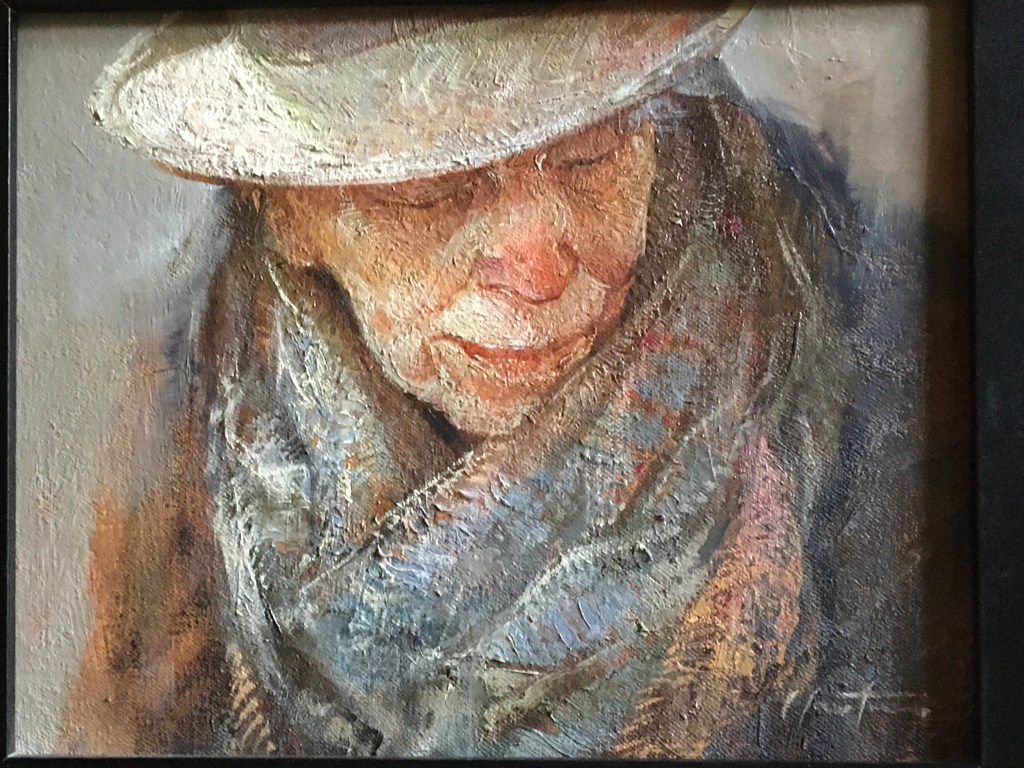
A portrait painted and a photograph. The former involves time, delves deeper, analyzes, sees beneath the surface. The latter captures a fleeting moment. Could one say a painting sees the soul, whatever that is, sees not only the person but the person in an interaction with the artist? Over a period of time, the time it took to paint it. A painting is time. A photograph is but an instant.
 Erika Bizzarri
I love this! ❤️🐶
xx
Deborah
LikeLike
Beautiful.
LikeLike
How many times have I heard you lament that you have nothing to say and that you you’re wondering what you would write this week? Ha! What you consider “nothing” is not what the rest of us see. Today is a case in point. As I used to tell my wordy students (without necessarily practicing what I preach) “less to say”often turns out to be “more.” These three Beginnings and the way they get woven together here work their own magic. Judi Dench, Shakespeare and lovely Antony the barista who is always studying to expand his horizons come together beautifully in the first of your three Beginnings. And why not? In the hands of a poetic wordsmith with a great imagination, ghosts of Orvieto past present themselves to receptive passersby. “Country-mouse” newcomers like me who have only been here for 16 years finally find out who those guys are with the “buzz cuts, all dressed alike in skinny black trousers and formal jackets and ties.”
And as for that “chameleon lady” well-loved by so many and who inspires portrait painters of all stripes while continuing to be a trusted Writing Partner to Diane? Don’t let her fool you into thinking she has nothing to say.
LikeLike