Lugnano in Teverina (August 1993)
You have to know it’s there
but even so
it takes you by surprise.
A tiny hilltop town
with down below
a far flung valley of olive groves
and fields of wheat.
We are politely informed
where to leave our car.
A narrow spiral staircase takes us to the road.
We cross and enter
a meander of streets
in an apparently abandoned town,
windows shuttered, doors tightly shut.
Someone though must have planted the
geraniums, four o’clocks, impatiens
lining the stone steps
leading to those doors.
The shadows deepen
as we continue under an overpass
where the vault overheard
bears the marks of reeds and plaster,
echoes of some Arab past.
Suddenly we emerge into the sun and
a few more steps
and there, off to the left, it stands,
down in the bowl of the town square,
ankle-high in cars which cluster round the porch,
glad to have found an empty parking space.
This is what we came for.
The medieval collegiate church
dedicated to Mary.
We stand here for a moment, mute.
The three of us.
You, John, and I.
Pilgrims gazing back into past centuries.
It looks more
like a temple than a church
for the dentils of the sloping cornice,
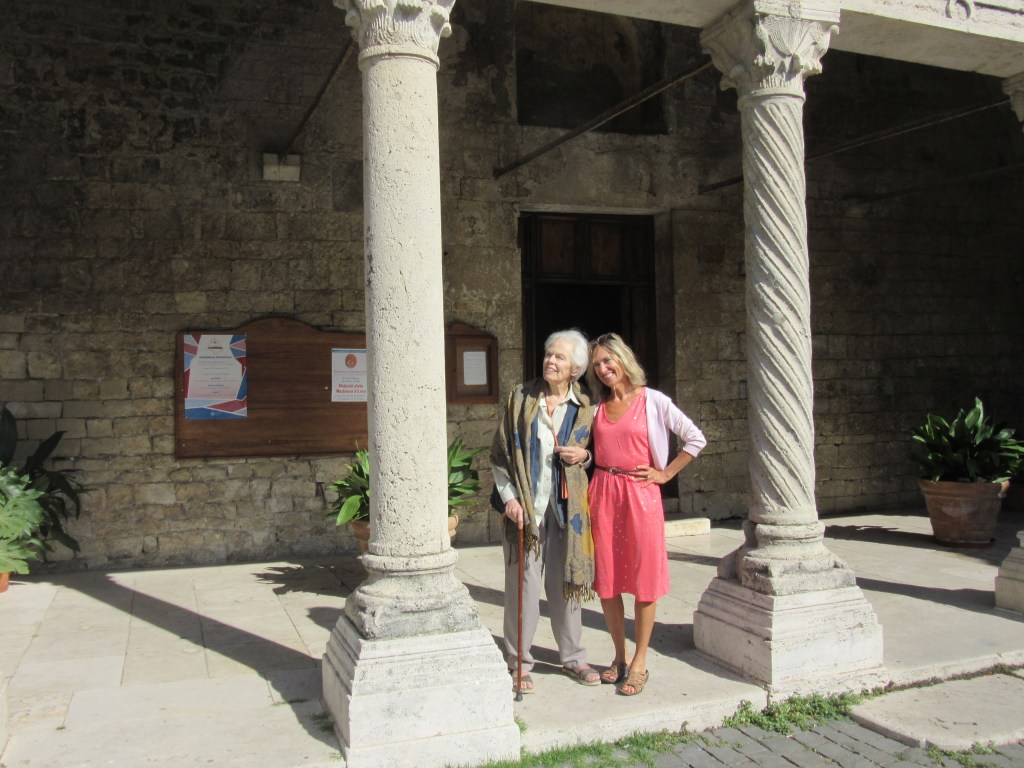
the columns on the porch, ***(photo columns Erika Annie)
speak a universal pre-Christian tongue,
not that of a more conventional
Christian church.
Perched on the gable, wings half spread,
an imperial eagle keeps watch.
Homage to Charlemagne
who, crowned by the Pope, passed here.
He surely must have spoken Latin.
Other eagles jut out from the facade
on either side the rose window.
The empty sockets clustered around the tiny oculus
once glowed with turquoise ceramic bowls from Persia.
Fragmented mosaic stars
that decorate the porch
call to mind the scribbles of a child
who, centuries ago, must have delighted
in filling up whatever empty space
he chanced upon,
unaware that pigeons, frost, war, neglect
would play havoc with his work of art.
Between the arches, stone cutouts of the Four Evangelists,
the lion of St. Mark, St. Luke’s ox,
St. Matthew and his winged man,
and St. John with his eagle.
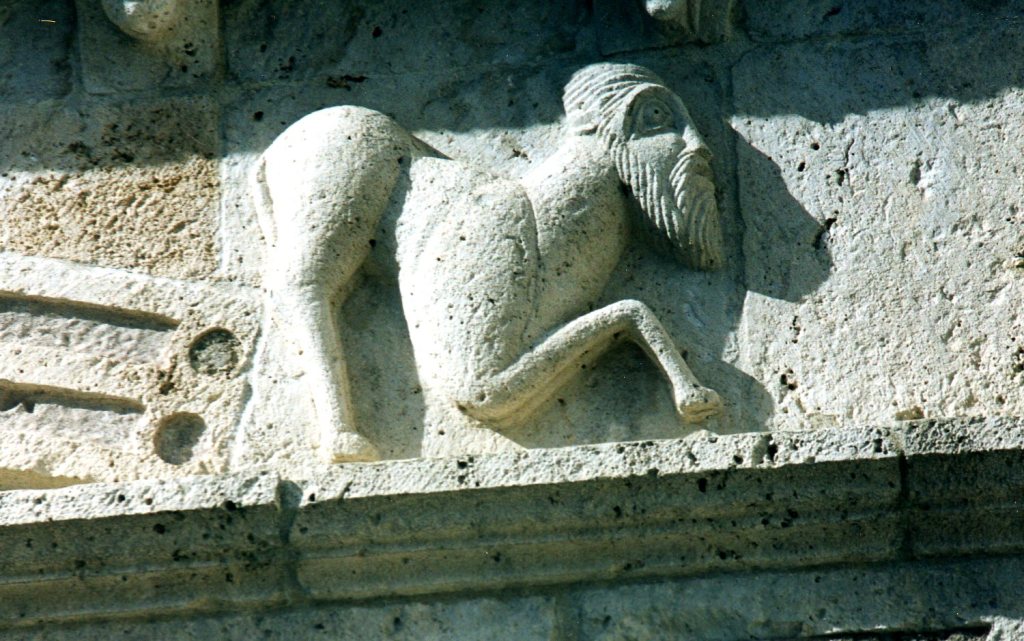
We wonder what that curious centaur on the right
gazing on a hooded being across the way – sheep or lion, hard to say –
is attempting to tell us.
We try to think away the centuries,
to see the porch, screened from the outside world
as refuge for the ill, for pilgrim wanderers,
comforted, and taught
by frescoes whose ghosts still hover in the vaults.
And then we cross the threshold.
The silence falls around us.
Silence and white shadows.
We feel intruders.
This is after all the House of God.
Yet emboldened by the fact that we are all alone
our whispers rise to normal speaking tone
for it seems to us that momentarily
there is no one here at home.
The mosaic floor,
a well-worn carpet of
small colored stones
set in interlacing motifs
like those on the façade,
lies at our feet.
White is for faith,
green for hope and red for charity.
“What a happy church” you remark,
your eyes dancing over the gay mosaic patterns
on either side the stairs
leading to the pulpit.
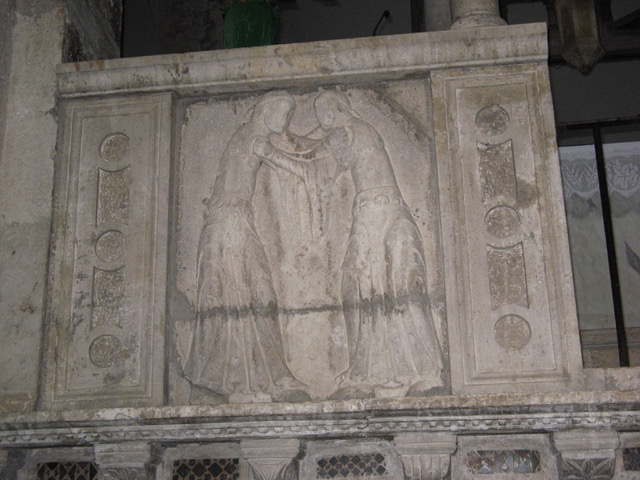
On the right hand panel
we mark St. Michael
eternally killing his dragon,
both turned to stone,
and on the left hand one
two men from Lorraine,
(from afar we had thought it a Visitation
but then we note one has a beard)
have been caught
in an everlasting embrace,
their pilgrim pouches dangling,
as they exchange their kiss of peace.
The column capitals on high,
some simple or basket weave,
amplify the story
begun on the façade.
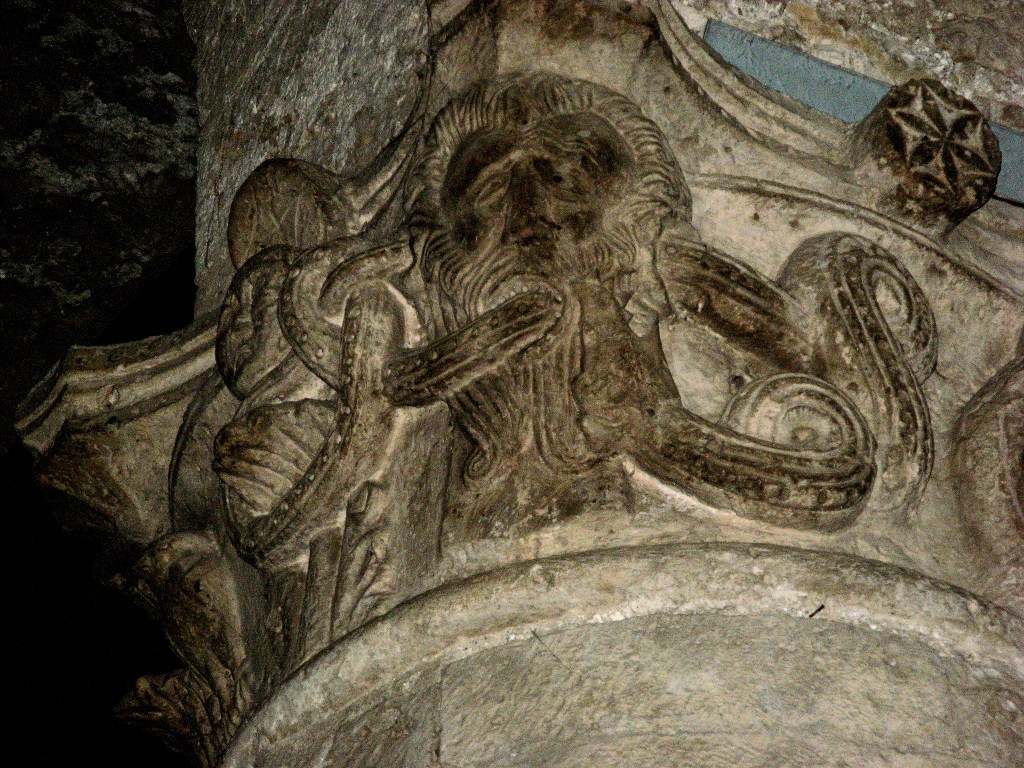
A monstrous face is enveloped in the coils
of a serpent, or perhaps a vine,
that issues from its mouth. (photo capital)
On the back side of a capital,
three figures are shown celebrating mass.
The priest, solemn in his frontal pose,
has both hands raised.
His left, three fingers, Trinity.
His right, thumb and ring finger joined,
the union of two natures,
human and divine, in Christ.
More than just the story of a child
but of a Christianity still in its infancy.
The booklet we picked up at the door
tells us that these gestures, Byzantine,
also gave the clue for chant and tone.
Music then was an integral part
of the church
in its nonage.
Without music,
it must have been incomplete.
Words elude us
as we slowly climb the steps
up to the altar harboring the image of the Virgin,
wondering
what that music would have sounded like.
As if in answer,
the church suddenly
fills with sound.
The song rises to the vaults,
fills every space,
so poignant and so sweet
it is almost more than we can bear.
Ave Rosa in Jericho…
Maria Phoeb….
Plena virtutis
Dominus natus pro homine
Tecum regnans
Matrem honorans…
What had been an empty shell
now has a soul
telling us that God is here.
Time has passed.
One century to another.
John is now singing with the angels,
echoes of his earthly song still linger
in the hearts of those who heard him
and in the Lord’s house he infused with life.
 Erika Bizzarri
What a remarkable, deeply affecting piece! The photograph of you and Annie (taken by John?) is a beauty. Although I never met him or heard his voice, through the understated power of your words, you have made its memory endure. Brava!
My favorite lines:
We try to think away the centuries,
to see the porch, screened from the outside world
as refuge for the ill, for pilgrim wanderers,
comforted, and taught
by frescoes whose ghosts still hover in the vaults.
—🥀from a very moved Diane
LikeLike
‘A happy church’ sounds exactly right, and such a happy and moving recollection too. A thought : your poem gives us the very deep past, the recent past and eternity in the present.
LikeLike
What can I say…This woman is a treasure!!!
Sending love,
Tom Tiberio
LikeLike
5/9/24Cara,Have just read your “elegy” LUGNANO !!!!!I think it is, for me ( having been there), the Best and most evocative expressi
LikeLike
A wonderful encapsulation of the spiritual and the atmosphere surrounding and embodied in the structure
LikeLiked by 1 person