It was the morning of June 14th, 1944. While a peace treaty with the Allies had been signed, the Germans were still hanging on and Orvieto was one of their strongholds. The not too distant Viterbo had been devastated and Major Heseltine, leading his squadron of British tanks, was approaching the city of Orvieto. His first view of the city must have been rather like that presented to George Dennis, the British consul and explorer, as described in his Cities and Cemeteries of Etruria in 1848. A magnificent scene, he said, an isolated height crowned with the towers of the city on its cliff-bound rock rising up over a wooded valley with a background of mountains, which looming through vapour and cloud, lost nothing of altitude or sublimity.

In Orvieto itself the Germans were still holding out and the city might have suffered the same fate as Viterbo. As Major Heseltine came in sight of the city, he was notified that a Volkswagen flying a white flag was approaching. The German commander Oberstleutnant Alfred Lersen proposed that Orvieto be declared an open city since the Germans had left, to which the Allied command readily agreed.
One might wonder why the German commander, who had been ordered to destroy everything as the enemy advanced, had taken it upon himself to disobey orders from on high. The answer was to be found in the fact that he and the bishop of Orvieto had become friends and shared a mutual love of art and music. Lersen, the last German commander left in charge, had ended up asking himself how one could wage a war when humanity could produce such wonders as the cathedral and the passacaglia of Bach. It might be said that it was music that saved Orvieto and its cathedral.
Or perhaps one could attribute it to the hand of God.
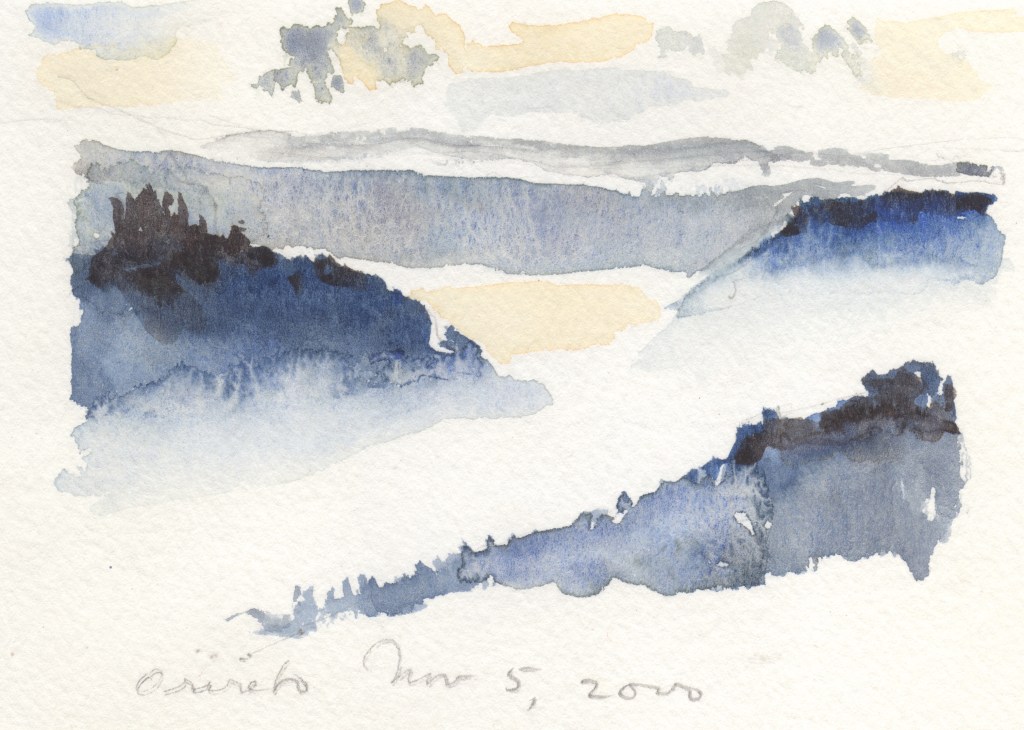
 Erika Bizzarri
Erika,
I have heard this wonderful tale in the past and, of course, the way you describe and paint it is simply….the best. I have read, perhaps incorrectly, that the German commander was influenced by the bishop of Orvieto who took it upon himself to befriend the German (perhaps against his better instincts?), and his efforts enhanced the possibility of Orvieto being saved.
Eighty years later, you and I and other fortunate people sit in this wonderful citta and marvel at what took place at the end of yet another horrible war showing man’s ability to hate and destroy in the sake of power and lust.
Can the lessons of history never be learned?
LikeLiked by 1 person
David Fuller is the fortunate guy who is in Orvieto and whose life has been made better by knowing Erika.
LikeLiked by 1 person
That’s a very moving story, and an inspiration; I did not know it. And such a beautiful painting Erika! Wonderful.
LikeLike
Erika
You have kept alive this moving vignette of history—of far more importance than the blessings and humanity of a few that saved Orvieto. This story is a parable for our current war torn world! If only…!
Brava
James
LikeLike
When will we ever learn…
LikeLike
A short and sweet history lesson – and lesson for humanity and kindness. There was no need to keep destroying people’s homes.
LikeLike
Grazie MILLE for explaining in such an eloquent but clear way the historical background of David Zarko’s excellent play. Although I had read earlier versions of it and saw the play when it was first performed here, I needed the “handles” you provide here.
I was so dazzled by the current venue and intent on thinking about the important issues the play raises that I was at risk of losing the thread of the story.
I hope that David’s play continues to have a life, especially with younger local students who may need to be reminded of their city’s history. If so, I hope that your piece will be made available to them and to any future audience. —💚Appreciatively yours, Diane.
LikeLike