Pre-dawn mental wanderings,
images of things seen, read and remembered
It is still dark enough, early enough, for the street lights to be on. How luxurious to stay in bed, knowing the day’s tasks can wait, not yet urgent enough to force me to get up. I pull the covers up around my shoulders. Makes no difference if I don’t start up the laundry for another hour. The dog will soon give me a single bark and then go back to her bed under the window when I tell her no, it’s too early.
I must think of things to write about, I tell myself. Since it’s dark, there are no distractions and my mind can wander as it will. Montale, that marvelous Italian poet who received the Nobel prize in 1975, said the best time for writing poetry is when you are drowsy, half asleep.
Yesterday. It’s what went on yesterday as well as what will go on today. Yesterday I watched and heard once more the story of what happened in 1944 when Orvieto was declared an open city. As David Zarko had his German commander say after listening to Bach in the cathedral of Orvieto: “It was the most extraordinary experience of my life. ….a blending into vastness. Vaster than a war effort, a social or political cause….How am I supposed to conduct a war after having been shown the workings of the cosmos?” I can’t help thinking, though, that as soon as one war is over, there will be another in the offing. There seems to be no end to the evil man is capable of.
A wind rattles the blinds. And then the image that materializes has nothing to do with war. My poet friend has sent me a poem and now I see a man standing on a height overlooking the sea while a lonely sea lion basks on the sand. It’s almost too warm and I push the blankets over to one side. My feet seek out the cool of the sheets. The sun casts the man’s shadow long over a treeless landscape. Can I remember the words of the poem he wrote? There was the tide and the sun and the waves breaking intermittently on the rocky shore. A feeling of being at one with the elemental world as he addressed the sea lion “there’s a layer of deep undisturbable quiet: a solitude like your own”. So like Caspar David Friedrich’s solitary figures, although his were watching the moon rise over a distant sea and not the sun making its way through the clouds.
As the sky lightens, a breeze makes its way through the open window. It is spring. A woman, perhaps it’s me, or perhaps it is the companion of my English poet, chances in her walk upon a sea of anemones, a carpet of light beneath the trees. Wordsworth had his daffodils and I have both as I read his poem to my mother, imprisoned in her armchair.
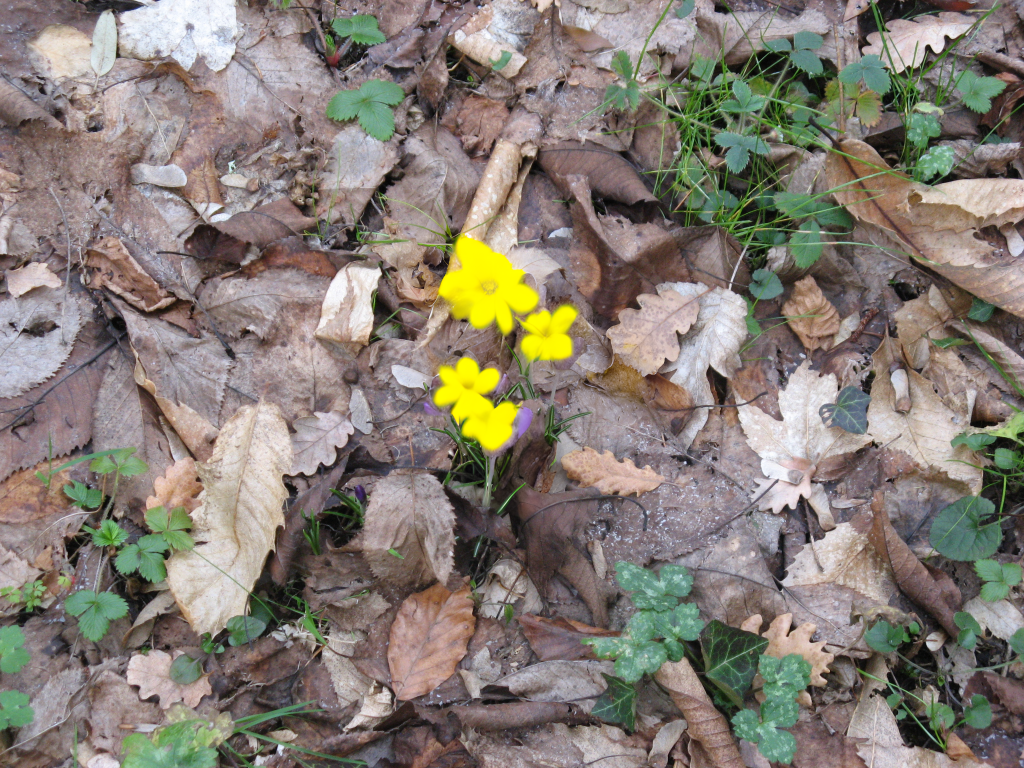
There I am back at the villa, alone by now, as I carefully maneuver the slope leading down to the road, using my cane to push aside the dry brown leaves so I can uncover spring’s first yellow crocus nuzzling its tender nose up towards the light. It is March and hazel catkins festoon the trees. Be careful, I tell myself, the other day you slipped and fell. At least you didn’t hit your head on that rock over to the side.

It’s not just me I have to think of. But it’s my children who keep telling me to be careful since having to take care of me would be a problem. When they were young they could wander the fields at will, finding pottery shards left by those who lived here centuries ago. Now, one of my children has made this his profession. How I wish his father were still around.
I leaf through the book by my pillow and encounter Tabucchi imagining what kinds of dreams Fra Angelico or Freud might have had. And there’s Count Rostov who never did tell me what his dreams were as he lived through a Russia in continuous transformation. I love his thoughts as he ponders on the importance or un-importance of “things”. I would so like to ask him what he thinks of Tabucchi, and of Pessoa with his multiple personalities, and the dream worlds they invoke. But then he himself is the creation, the dream, of Amor Towles. So who would I be asking? Count Rostov – the Gentleman in Moscow – or Amor Towles?
Before I drift back off into sleep, a phrase makes its way into my consciousness, but where it comes from remains a mystery. The stark beauty of the night. Have I read that somewhere? I turn on the light and jot it down before it is swallowed up by my other early dawn meanderings.
Thoughts and pictures arising in the pre-dawn dark, the best time to give one’s imagination free rein. You’re quite right, Montale, but one must also sleep — and dream.
 Erika Bizzarri
i so enjoy your blog. Keep them coming. Love, Cindy
LikeLike
<
div>So often
LikeLike
Really enjoyed your pre-dawn wanderings. Mark.
LikeLike
So grateful to hear your voice and your meanderings. Love
M
LikeLike
I find your meanderings really interesting Erika. I did not know that Montale considered the best time to write poetry to be when one is drowsy, half asleep; I would have expected the opposite to be true, the choice of words needing the utmost clarity, but then I would not want to bat against Montale! I like the way your half-asleep mind wanders through various recollections, getting them half right, letting them drift on into new dimensions. Just the way our minds work when only half awake. Perhaps I begin to see what Montale meant, if he was thinking of how the mind needs to be off-guard, letting itself be taken by surprise; the exact choice of words can be left til later when the mind is fresh and able to reason. Very interesting.
LikeLike
I love the subtitle of the ruminations of this articulate wanderer: images of things seen, read and remembered. And as one who, as you know, likes to wake up early and physically wander nowhere, I, Diane, especially like the opening paragraph.
LikeLike