Seems the Japanese are particularly good at that, aside from
Marie Kondo. Keep only what you really need, what is essential. Two pairs of jeans are quite sufficient – one to wear while the other one is being washed. Coffee cups? Generally, you and your partner need only two. If friends come they will have to bring their own. If you see new cups that really delight you in a shop and can’t resist buying them, throw out the old ones, or at least give them away. There’s only so much space in your living quarters.
On the other hand, all this is fine as long as you’re young, when you’re living in the present. But as time passes, as your acquaintances turn into memories, you might also like to keep those objects that can bring back memories and a former life and experience. And that is when you hesitate, you turn to those objects to help you continue living. Don’t our lives consist of memories? Isn’t that what we’ve invented words for? Not just to help us communicate with each other, but to communicate with ourselves, with our past. Without that object to stimulate our memories, we would be so much poorer.
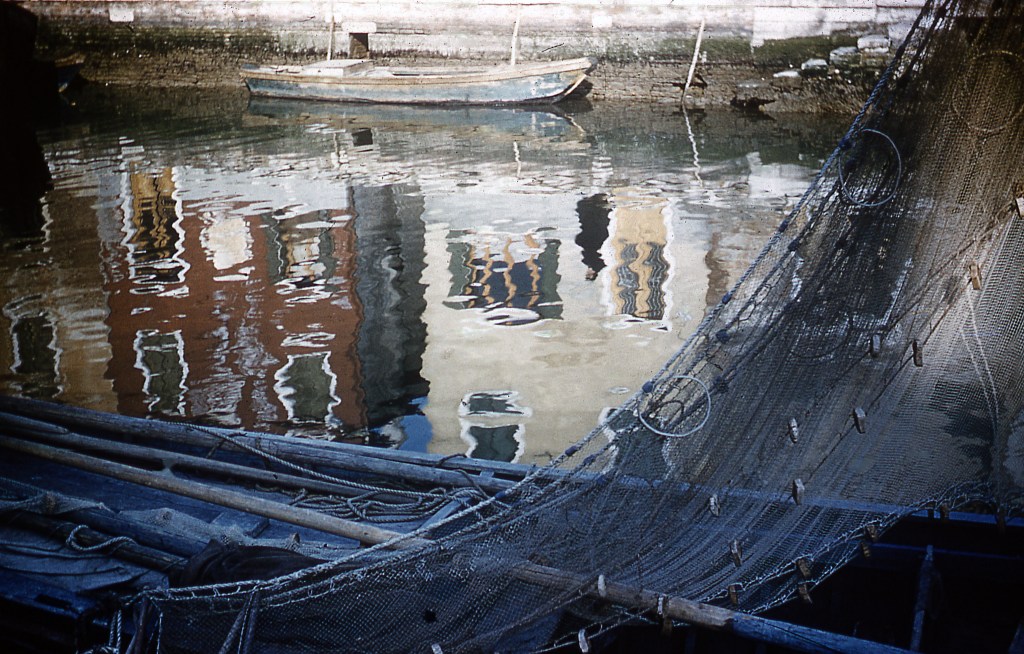
Take that poster I got when I saw an exhibition in Venice, together with a friend whose memory is now inseparable from that exhibition. Just as Venice in June is now part of the whole as is the water in the canal, the cats sitting outside the museum. The rooms we stayed in with the students, the mirror that turned out to be a door. The teddy bear a student left behind and that the hotel sent on to our next stop. That teddy bear (or maybe it was a rabbit) was a present from her boyfriend and meant the world to her. I no longer remember her name but can still see the joy in her face when she once more clutched this love token to her heart.
While the physical space we live in is finite. that in our memories is infinite.
 Erika Bizzarri
And you, dear Erika, are a part of my present and past. And deeply cherished.
James II
LikeLike
What an intriguing reminiscence, about the trip to Venice and its aftermath: the teddy, the forwarding to your next hotel and the joy of its rightful owner. What you show us without words is that somehow you and your friend managed the reuniting of student and teddy!
So that’s minimalism is it?!
LikeLike
True I got sidetracked into memories. but after all, as Count Rostov sometimes forgets, memories are what count. So why did he keep his sister’s scissors? That at not much more – so that also is sort of minimalism.
LikeLike
Reminds of Epicurus!
LikeLike
Hi Erika,
What a lovely poem. And particularly poignant right now.
Frank’s sister Rita died Wednesday. The Thursday before she had an unexpected and massive heart attack. They put in a stent but she was still having trouble after and a scan showed a hole in her heart which they were unable to close. She had been unconscious the last 4 days and was on life support so we didn’t get a chance to speak with her, which was very hard for Frank.
Overall this has been a difficult time for Frank. I know he is already looking forward to returning to Orvieto.
I hope you are doing well and continuing to recover and look forward to seeing you in a couple of months,
love,
Candace
>
LikeLike
As you know, I am a lover of talismans and write about them often. As the owner of a Magic Flying Shirt that keeps the plane aloft, I like these words that describe touchstones as “totems of belonging and safety.“ They come from a colleague who views the idea of “writing about objects as a means for bringing the past to vivid life… Memory is an elegy directed toward an object vanished into one’s past, but also a celebration, a hymn, to those moments that the mind assembles.”
I’m not sure how Marie Kondo whose ideas we have often discussed would respond to this kind of thinking. But I think that you and I are on the same wave length about touchstones and memory, and of course about many other things, as well. From Diane, your forever writing partner. ✍️✍️
LikeLike