SCARVES, STOLES, SHAWLS OR WRAPS
Stole, shawl, cape, boa, or pashmina. Or, perhaps, if you go back far enough, you get to toga.
When I was working on a translation of Saint Charles Borromeo’s manual on church building and decoration, a stole was a liturgical vestment, on a par with a chasuble and surplice, and symbolized priestly authority. A stole was something imbued with a specific meaning. Like the toga. A stole worn by a woman is quite another matter and calls to mind parties and evening wear, flappers of the 1920s and sequined shawls and feather boas. Not that a priest’s stole can’t be elegant and an object of beauty, with the excuse I suppose that it is in honor of God. St. Francis on the other hand refused signs of luxury and wealth and went in for sackcloth, which however I can’t imagine in a stole or shawl version.
What matters is that this oblong piece of cloth is to be wrapped around your shoulders or your neck, with the ends thrown over your shoulders. There surely are some fine examples throughout history aside from Roman togas, which covered the whole body. Artists throughout the centuries have found scarves a source of inspiration. Often simply because they needed that splash of red or gold in a painting. Rembrandt did occasionally use a scarf as a prop, but artists such as Modigliani and Soutine found them particularly useful. While many of the paintings by various artists don’t necessarily contain scarves, their paintings may by themselves be the subject of a scarf, take for instance Klimt.
My first thoughts on scarves bring me the image of a man in a black cape with a red scarf tossed around his shoulder. Toulouse Lautrec and his poster of Aristide Bruant. First, I thought of Degas, but then I realized the artist I wanted was Toulouse Lautrec. And it has to be a red scarf. Like the one I’m wearing standing in front of a door with a Christmas wreath together with my friend Carolyn.

I think the scarf belonged to my friend Csaba but was what was needed here. In a drawer at home, I also had a red scarf that belonged to Santa Claus. He sometimes lost it on his way back up the steps after leaving his gifts under the tree. We did have to explain to my granddaughter why she could never catch sight of him. There is so much more to a scarf than just a piece of fabric.
Aside from my silk scarfs I have quite an assortment of long heavier scarves or throws. Since their purpose is warmth more than decoration, if they have patterns it is more likely that they are woven rather than printed, which also means they have a reverse side. Often they are in wool, or purport to be. Many scarves are now listed as pashmina although that term should correctly be limited to a variant of the cashmere shawl or a cashmere and silk blend.
Many of my scarves were chosen for their color combinations, such as turquoise and lime, or tones of wine or pink and grey. Yet now looking over my many many shawls and scarves I find an impressive number very neutral in color – grey blending into black, or tan, or simply warm dove grey. All that with a mind to being “fashionable”, making sure the stole harmonized with my outfit. Counting them, I note there are over 24 stoles, carefully rolled up, in my storage space.
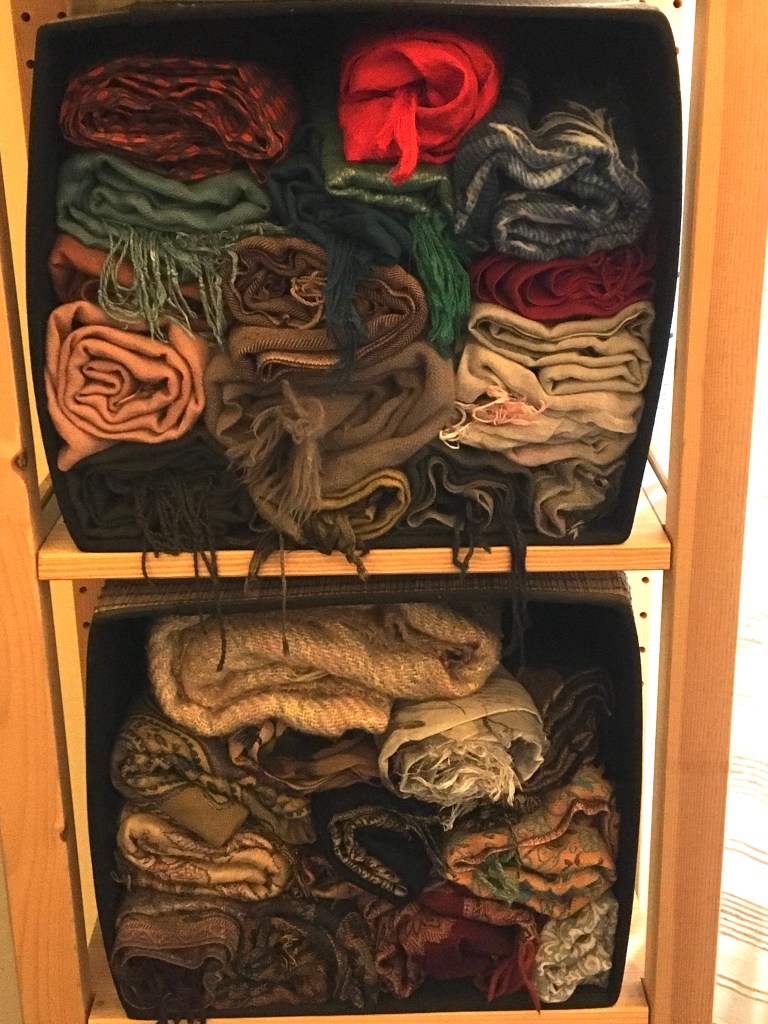
Historically, and since it is over 70 years ago ,I guess I can call them historical, are the rebozos I loved when I was a student in Mexico.
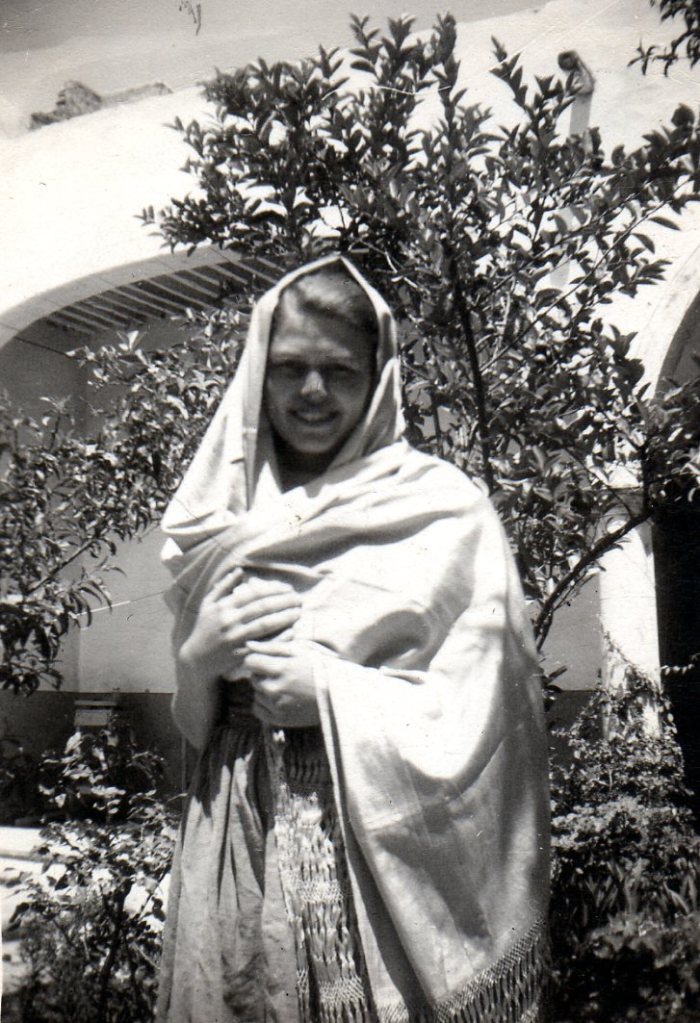
In this I was not alone for the American girls in general adopted the style. With its rich fringed ends, a rebozo was draped crosswise across one’s breast, or over the head. “There’s a thunderstorm coming,” the Mexican women I encountered would tell me as I was walking the streets of San Miguel Allende in1949. “Cover your hair – it attracts the lightning.” True, those years I had rather a wild head of hair but I was never struck by lightning.
Special memories? Not nearly as many as with my silk scarves. One brocade comes from Florence and I can see the cart and the vendor with the dark wall of the church (might have been San Lorenzo) rising up behind it. My friend and I vied with each other in being the first to get our hands on a brightly colored turquoise one. She beat me to it. Occasionally, a scarf will call to me as I pass it in the street, and although I don’t really need it . . . Does one ever really have enough scarves or stoles? Scarves and stoles are such ideal gifts. One particularly lovely one comes from the Met (how many gifts have come from there!), and I shall always be thankful to the friend who convinced the givers that it would be much more suitable than another t-shirt.

Historically, there is the shawl my mother and father took turns knitting on the steamer coming to the US. It was for my father’s grandmother and I still keep it in my chest although it is no longer usable. The most precious historical shawl I have is the one made by Fernanda, my Bizzarri mother-in-law. At this point certainly over a hundred years ago, it uses three techniques – knitting, crochet, and. . . oh dear, someone help me to come up with the right term. Suddenly, there I have it – macramé.
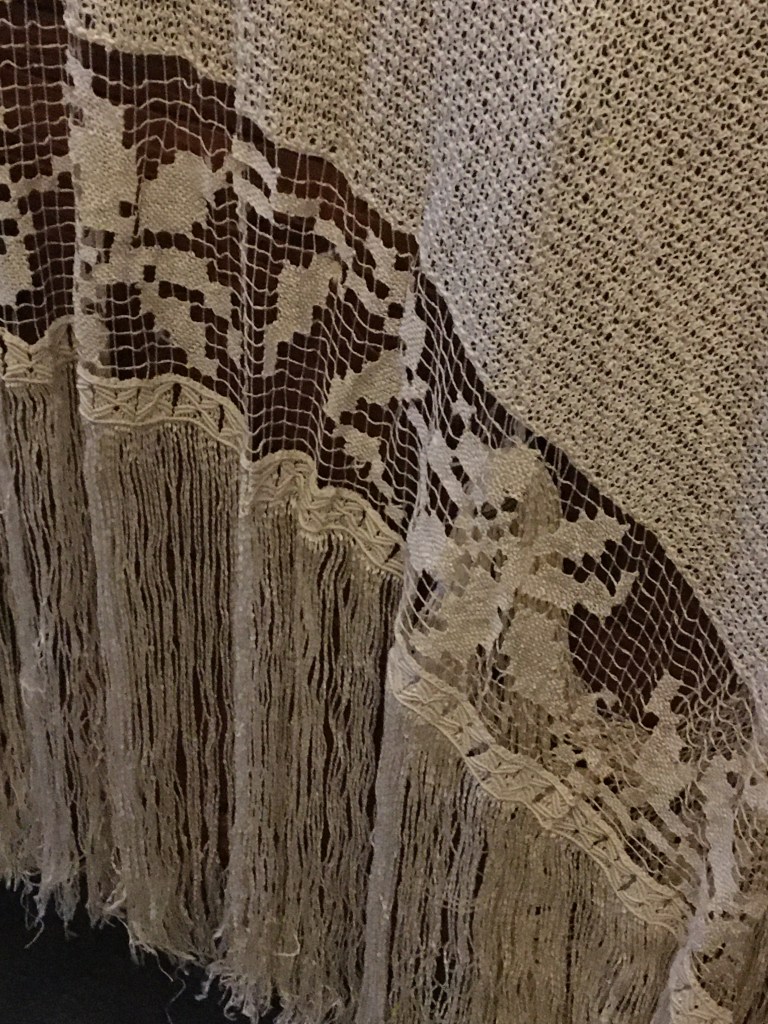
The Internet is now packed with pictures of shawls but none of them will have that recondite significance only you or I are aware of. A shawl or a scarf is after all so much more than just a piece of fabric.
 Erika Bizzarri
Wh
LikeLike
Buon giorno, Ernie.
???
LikeLike
I never before thought of scarves in so many ways. You must also have an amazing way to organize your old photos to fine just the one you need.
LikeLike
I didn’t mean to make that commento anonymous, it was me. Mike Shaughnessy
LikeLike
I’m pleased you decided to include those two photos of you, Erika; stylish then, stylish now! And it is indeed interesting to reflect on how the scarf (by whatever name) combines extreme simplicity of form with infinite possibilities of expression.
For the male human the necktie is the nearest equivalent. I don’t wear them in retirement although for forty years they were the small part of my office uniform that gave me the greatest opportunity for self expression – working with simplicity of form.
However, the tie cannot compete with the scarf with all those variations of culture. Keep wearing them please!
LikeLike
True, ties can’t compete. At least not now. Once they were the gift for your husband, father, lover, man. People who wear ties now are few and far between. At least in Italy. Last time I went to see a doctor for a Doppler, he was the most elegant man I’d seen in a long time. I remarked on his tie. I worked in GB he said and you had to wear a tie.
Aside from that, John Looker also looks quite elegant in his photo.
LikeLiked by 1 person