Bruschetta, the likes of which there is none other. And please, please, don’t pronounce it with an sh sound. It is brusketta (like kettle).
So what is it and where does it come from?
The two main ingredients (well perhaps three) are the new olive oil and what can be considered real bread. By which is meant the sourdough variety, with the lovely Italian name of lievito madre or mother yeast, baked in a wood-fired oven. In an Italian grocery store or bakery you can specify that you want “pane cotto a legna”, although pane casareccia is similar but is not necessarily baked with a wood fire. In Umbria and Tuscany, the bread will be without salt, leading some uninformed American visitors to denigrate Italian bread. Supposedly the lack of salt is the result of a 16th-century tax on salt the people refused to pay the papacy. So they simply made bread without salt. Until 1974, salt was a monopoly of the state and could only be sold in authorized shops. One year a friend of mine was stopped by the police as he was transporting salt water from the ocean to his aquarium in Orvieto. He had to empty out his tanks although I don’t see how he could have transformed a carload of ocean water into salt.
The prime ingredient for bruschetta is of course the new extra-virgin olive oil, that green-gold liquid straight from the mill. One can of course use any extra-virgin olive oil but connoisseurs will know the difference. Visitors to Italy now also demand that restaurants place a bottle of olive oil on the table so they can savor bread and oil as they wait for their dish of pasta. Butter is practically unknown as an accompaniment to bread, except sometimes appearing with the hors d’oeuvres where curlicues of mountain butter are spread on bread and then topped by a salted anchovy.
But for bruschetta what we have been waiting for is the new olive oil and the time is ripe. That is the olives are ripe. It is November or maybe December. The dark purple or green olives have stopped playing hide and seek with the silvery green olive leaves, whether the trees are of the Leccino or Moraiolo variety with black olives, San Felice with green fruit, or varying in color with the Rajo, Dolce Agocia or Frantoio varieties.
Friends and acquaintances have agreed to take the day off from their regular jobs and converge on one or the other of the olive groves where the owner has prepared everything for the harvest while the lady of the house is busy making an end of day dinner for the participants. The grove is filled with cheerful chatter as long nets are stretched under each tree and ladders are leaned up against the branches. More daring souls will even climb up into the tree to strip the olives from the topmost branches.

Once filled, the bags are then emptied into boxes, removing as many leaves and twigs as possible. Olives that have fallen are picked up from the nets or grass, as the oldest of our crew remember how one year they had to brush away the snow.
An appointment has already been made with the olive mill, for the olives have to be pressed as soon as possible. Hopefully the old-fashioned mill with a granite millstone is still functioning. For centuries that is how the olives have been turned into a mash, which is then layered between round fiber mats and pressed. A millstone, currently lying idly in one of the caves with which the tufa cliff of Orvieto is riddled, bears the date 1697. Now most establishments no longer use this age-old system but give preference to a continuous cycle with an endless screw inside a perforated cylinder.
It is finally the turn of our olives, for the oil we get is from the olives we have harvested. Soon a rivulet of emerald green liquid flows into the great vat. This is extra-virgin olive oil, obtained from the first pressing and using solely mechanical processes, without heat or solvents.
Were you aware that there are rules for judging oil, just as there are for wine? The technique includes swirling a teaspoon full of oil around in your mouth to get the full flavor. Only then can you pass judgment and list which of the thirteen positive attributes, ranging from ripe fruity to pungent, are indicated, hoping none of the negative ones, of which there is also a long list, including musty and metallic, will be required.
Stored for the coming year in tins, wary of light, we can’t wait to try it.
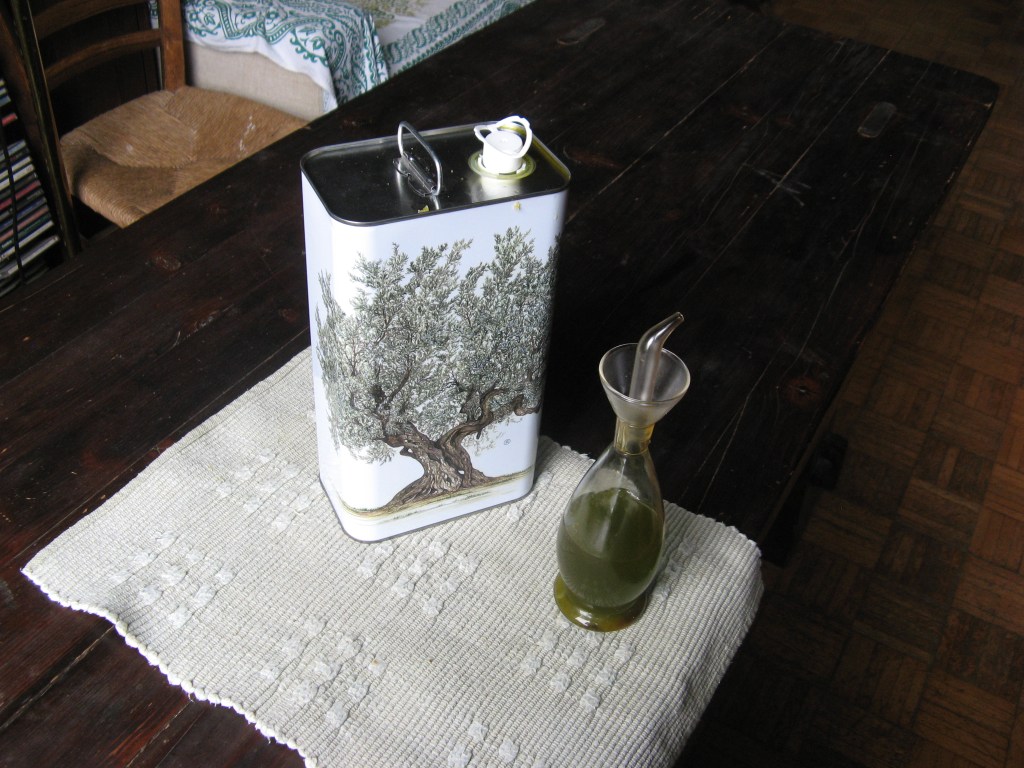
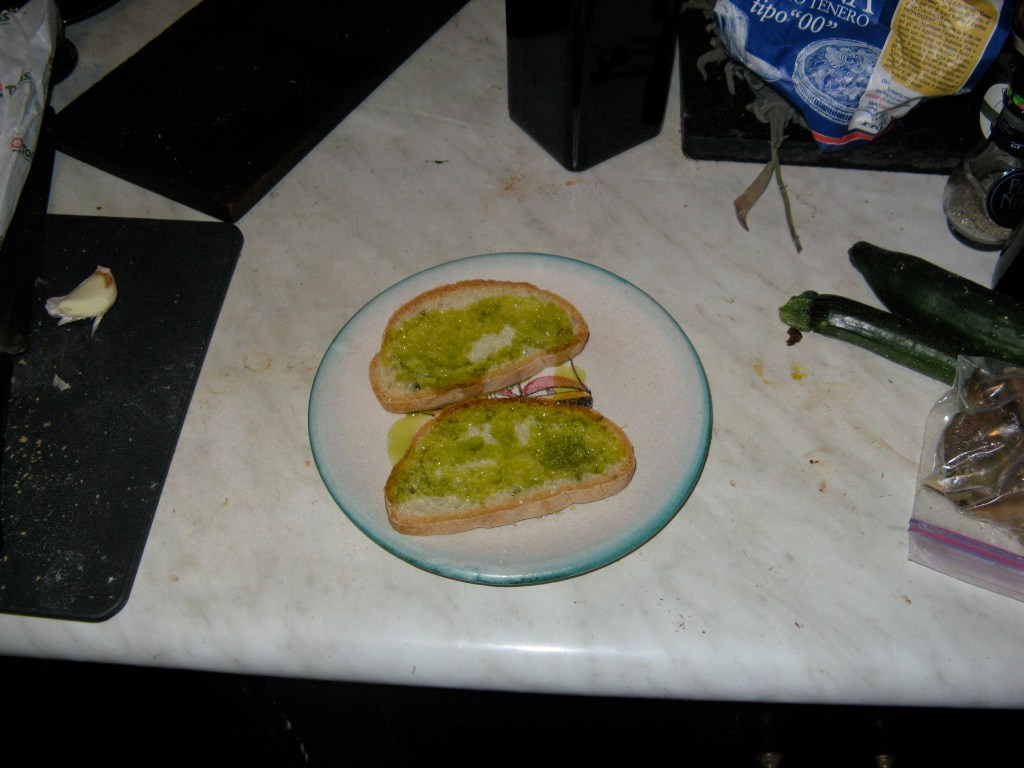
So, get that bread ready. The embers glow in the fireplace, the bread is toasted or bruscato, from whence the term bruschetta, and for tasting purposes is then simply inundated in oil and sprinkled with salt. Accompanied by a glass of wine.
This is the moment when newcomers to Italy are introduced to what I call bruschetta (remember “brusketta” like in kettle). My son, who teaches a course on the food and wine of Italy, has his students come to a special bruschetta session. The bread is grilled, the students help by rubbing each slice with a clove of garlic, and then that lovely new oil is poured over each slice before sprinkling it with salt. Pure heaven! That is what I call real bruschetta where the tang of the new green oil lends its peppery accent to every mouthful.
Toasted bread topped with chopped tomatoes is also often called bruschetta. But for me that is a derivative, an illegitimate offshoot. I want my bruschetta in what in wine terminology is called in purezza– in other words “pure”. With just plain extra-virgin olive oil and a sprinkling of salt.
There’s absolutely nothing like “pure” bruschetta!
 Erika Bizzarri
How timely Erika, this Sunday I am preparing a pasta dinner for four of my neighbors. I will strive to duplicate this bruschetta to go with it.
LikeLike
This brought back many wonderful memories of our own olive harvests, which are a relatively new ritual in our lives. We planted 5-year-old trees which we picked for the first time when they were 8. That was truly extra-virgin oil! There wasn’t a lot of it, but we couldn’t believe its sumptuous taste and color.
We take photos and I always like to write about the experience in my blog, “In Love With France, At Home In Italy.”
We remember and miss Farmer Galli who along with his dear family used to help us and taught us so many things. This year will mark our 12th harvest, which feels like a milestone that will never get old. What a gift to feel in harmony with nature as she shares her bounty!
LikeLike
Hi Erika. Your bruschetta post made my mouth water. How I loved the smells and tastes of those delicious snacks made with rustic bread, garlic, and olive oil. Here, every restaurant offers a tomato sauced toast with pizza like toppings and they call it bruschetta. I suppose they have figured out the American palate.
<
div>Alas, there aren’t many places where we can buy truly virg
LikeLike
Lovely descriptive writing as always… I shared this to my Facebook page. I think I have a number of friends who will enjoy reading it.
LikeLike
Lovely descriptive writing as always… I shared this to my Facebook page. I think I have a number of friends who will enjoy reading it.
LikeLike
I shall remember your eulogy to bruschetta whenever we are offered it here, in England, in Italian restaurants!
LikeLike
My mouth waters! I am expecting guests for dinner tomorrow night but, alas, I cannot offer them genuine Umbrian oil! I look forward to sharing some with you in October!! Baci, abbracci e li mortacci ai poveracci (chi non ama la cucina umbra!!!)
LikeLike
Accordo con le parole di James ! So many happy memories of those bygone days ! By the way was the photo from “6 Loc Cappuccini”? looks familiar and the date accords with our records. Kay is just browsing through a favourite Italian cook book and recalling wonderful meals of the “Cuccina povera”.
LikeLike
Yes, dear Csaba. Only photo I had of picking olives. Wasn’t taking many photos in those days. Miss you, as does Mark, for whom Orvieto is Kay and Csaba morethan the Domo.
Buona giornata. Do you get good olive oil there?
LikeLike